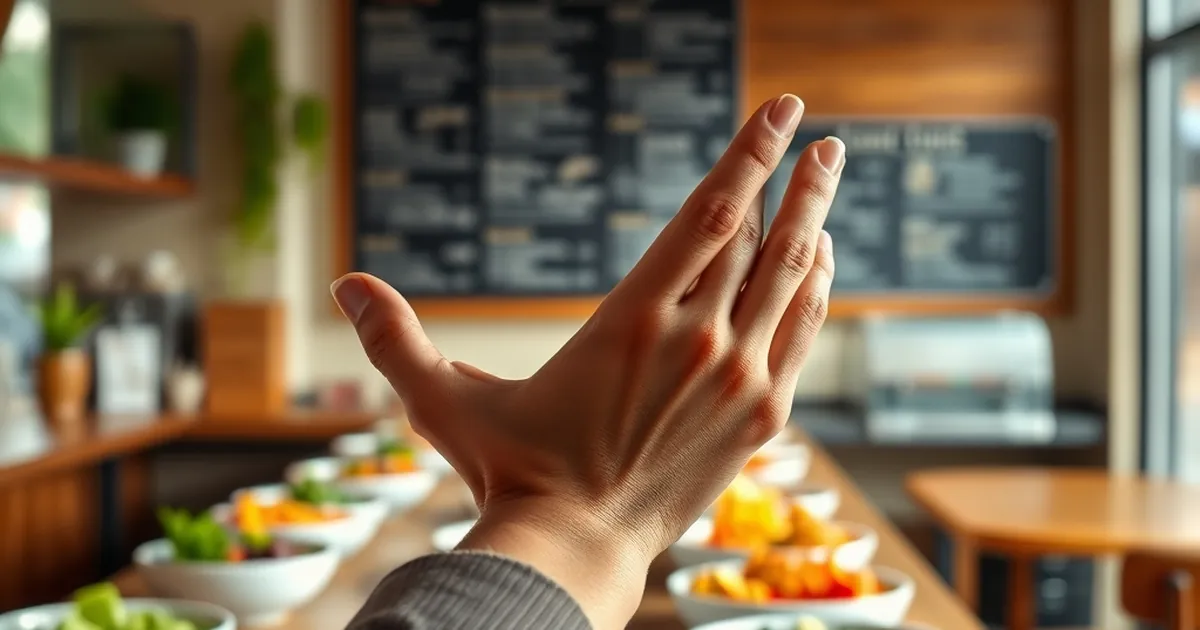
You've seen it at every fast-casual lunch spot: the chalkboard with twelve grain bowls, each one a small essay about tahini and pickled things. And you've felt the tiny stall — the eyes flicking back and forth, the phone coming out, the half-apology to the person behind you. The question isn't whether long menus feel harder. It's why a menu of twelve takes measurably longer to order from than a counter with six pre-built bowls, and what that stall is actually doing to your lunch, your mood, and your appetite.
The Stall Is Real, and It's Measurable
Choice overload has been studied since at least 2000, when Sheena Iyengar and Mark Lepper set up a jam-tasting table in a grocery store. Shoppers who saw 24 jams stopped to look more often than those who saw six — but only 3% of the big-display group bought a jar, versus 30% at the small display. More options drew attention and suppressed action.
The time cost follows the same curve. In eye-tracking studies of menu scanning, decision time rises steeply as item count grows and then flattens — but the flat part is still slow. Twelve items isn't twice as hard as six; it's a different cognitive task. With six, you can compare every pair. With twelve, you can't, so you start building shortcuts: eliminate by category, ask the cashier, default to the thing you got last time.
Comparison Is the Expensive Part
The psychologist Barry Schwartz describes two strategies: maximizing, comparing every option to find the best, and satisficing, taking the first one that clears your bar. Long menus push almost everyone into maximizing mode, because if twelve options exist, one of them must be the best — and picking wrong feels like a personal failure rather than a coin flip.
That's loss aversion doing quiet work. Kahneman and Tversky's framing showed that losses loom larger than equivalent gains, so a bowl you regret stings more than a bowl you love delights. Every additional item on the board raises the imagined cost of the wrong pick, which raises the time you spend avoiding it. The menu isn't just longer. It's more expensive to get wrong.
Reward Loops Behind the Counter
There's a second force at play, and it's on the operator's side. Customization — the build-your-own bowl, the twelve-topping bar — creates a variable-ratio reward structure. Order the same base with a different combination and you get a slightly different lunch. Behavioral work on variable-ratio reinforcement, the same schedule that makes slot machines so sticky, explains why "I'll try the harissa one this time" feels more engaging than "the turkey sandwich." Predictability is boring. Variability keeps people coming back.
The tension is that variability is delightful on visit five and paralyzing on visit one. Cafés that nail this usually do it in stages: a short core menu for newcomers, a rotating specials board for regulars. The choice is still there. It's just sequenced.
What This Means for Your Next Lunch
If you're the one holding the menu, the practical move is to decide your criteria before you read the items — protein, heat level, something green — and take the first bowl that clears all three. Researchers call this an elimination-by-aspects strategy, and it collapses twelve options into a short list in seconds.
If you're the one writing the menu, the forward-looking question is sequencing rather than trimming. Six signature bowls, clearly described, plus a "make it yours" line for the people who want to play. Watch what happens to your line speed and your average ticket. The stall isn't indecision. It's arithmetic — and you can design around it.