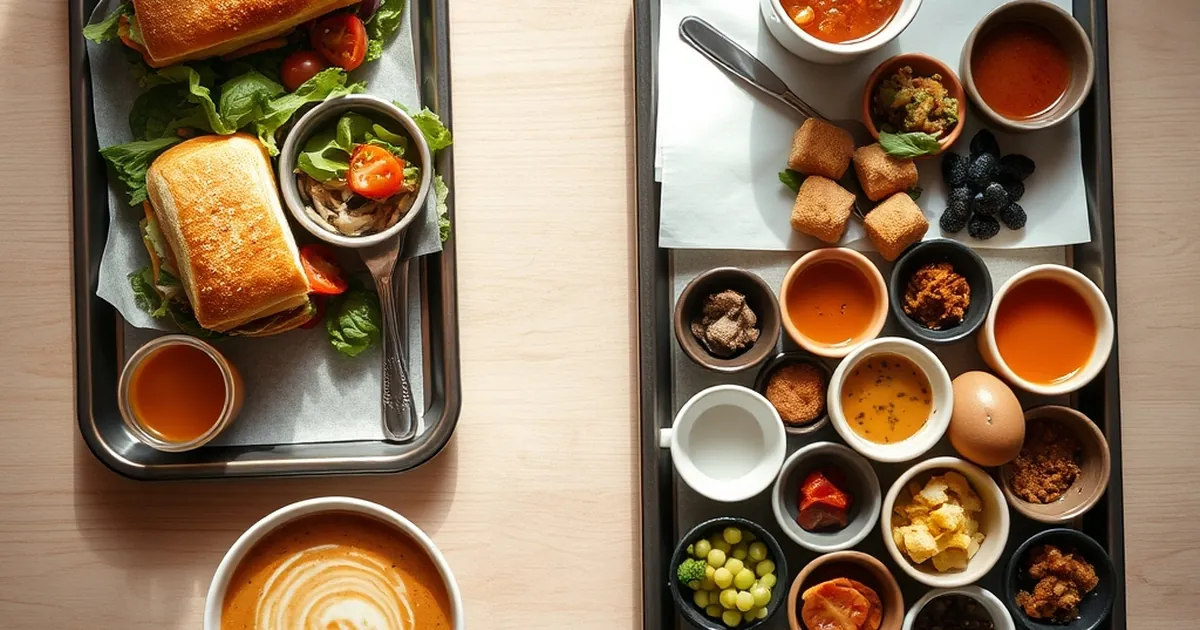
Picture two cafés on the same block. One sells a fixed lunch combo — sandwich, side, drink, one price. The other lets you build your own from the same ingredients. If the same person eats at both places a few times, which one do they return to? That's the question worth chasing, because the answer has less to do with food quality than with how our brains handle decisions when we're hungry, rushed, and running low on willpower.
Choosing Is a Tax, and You Pay It at the Counter
Behavioral economists call it decision fatigue. The more choices you stack in front of someone, the worse each subsequent decision gets — and the less satisfied they feel with whatever they pick. The classic demonstration is Sheena Iyengar and Mark Lepper's jam study: a display of 24 jams drew more browsers than a display of six, but the six-jam table converted roughly ten times as many sales. More options, more interest, fewer purchases.
A café is a jam table that resets every day. Build-your-own menus look generous, but each add-on is a small cognitive bill: bread or wrap, which protein, which side, which drink size. By the time the customer reaches the register they've made six micro-decisions before noon. The combo collapses that into one. It's not that the combo tastes better — it's that choosing it costs almost nothing.
The Combo Is a Reward Loop With a Clean Finish
There's a reason the fixed meal feels complete in a way the build-your-own doesn't. A combo has a defined endpoint. You know what you're getting, you know when the decision is over, and you get a tidy little hit of closure when the tray arrives assembled as promised.
That's a reward loop in miniature: cue (hunger, line, menu board), routine (order the number two), reward (predictable, complete, no regrets). Predictability is underrated as a reward. The build-your-own customer gets novelty, which is genuinely nice — but novelty also invites the small sting of second-guessing. Should I have gotten the soup? Was the upgrade worth two dollars? Regret is a cost, and it shows up in whether someone comes back.
Loss Aversion Hides in the Add-On Menu
Kahneman and Tversky's loss aversion work tells us losses loom larger than equivalent gains. On a build-your-own menu, every add-on is framed as a potential loss: skip the avocado and you might feel you shortchanged yourself; add it and you've spent more than you planned. The customer is quietly negotiating with themselves the whole time.
The combo sidesteps the negotiation. One price, one decision, no imagined version of the meal you didn't order. That's why combos "win rematches" — the second and third visits are where decision fatigue and regret compound, and the fixed option keeps dodging both.
What This Means for the Counter
If you run a café, the takeaway isn't to kill customization. It's to make the default path effortless and the custom path available but quiet. Put the combo first, price it clearly, and let the build-your-own live one step down the menu. Watch your repeat customers — the ones who come back twice a week — and notice which line they order from. That's your real data.
And if you're the customer? Notice the next time you stand in front of a long menu and feel a flicker of dread. That flicker is information. The meal that ends the decision fastest is often the one you'll be happiest you chose.