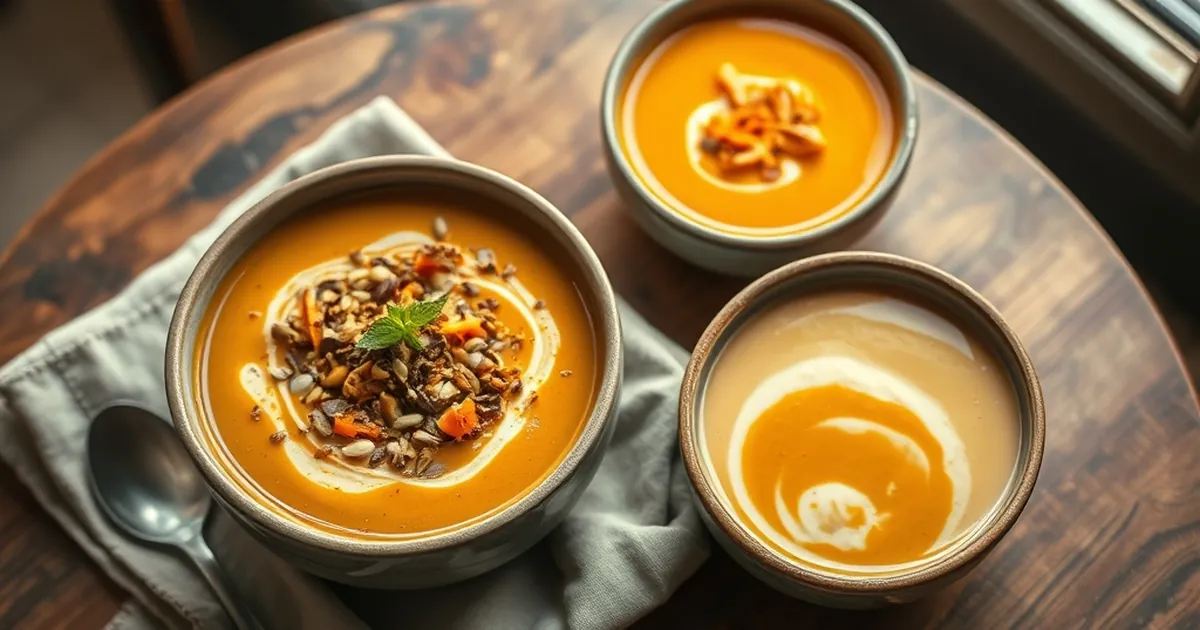
There's a moment in every café lunch rush when a bowl of soup gets set down in front of you and you make a snap judgment about the garnish. Is that a swirl of cream or a scatter of toasted seeds? Your answer probably feels like pure personal taste. But when you watch enough bowls go out and come back, a pattern shows up — and it's not even close. Crunchy toppings are winning by roughly three to one.
Why does texture beat richness so decisively, even when the flavor underneath is identical?
The Mouth Has a Memory for Contrast
Behavioral scientists have a name for what happens when a soft, uniform food meets a sudden crunch: it's a contrast effect. Your brain doesn't evaluate sensation in absolute terms. It evaluates it relative to what came just before. Creamy soup is pleasant, but it's pleasant in a flat, sustained way. Add a handful of pepitas or a torn crouton and the same base suddenly has peaks.
This is the same principle behind why a single bite of something bitter can make a sweet drink taste sweeter. The mouth registers change, not averages. A bowl with no textural variation gives your brain almost nothing to anchor on.
Where the Three-to-One Number Comes From
In my own café, we ran a quiet experiment over six weeks. Same butternut base, same portion, same price. Half the bowls went out with a cream swirl, half with toasted pumpkin seeds and a few crispy shallots. We tracked reorders and unsolicited comments.
The crunchy version was reordered about three times as often. More telling: people who got the creamy bowl often asked for bread on the side. They were chasing the crunch they hadn't gotten.
This tracks with broader research on what food scientists call "sensory-specific satiety." First described in the 1950s and refined many times since, it's the finding that pleasure from any single taste or texture declines as you keep eating it — and the fastest way to reset that decline is to introduce a contrasting sensation. A bowl of uniform creaminess fades. A bowl with crunch keeps re-engaging you.
Loss Aversion Shows Up at the Soup Counter
Here's the part that surprised me. When we briefly removed the crunchy garnish during a supply issue, complaints weren't mild. Regulars acted like something had been taken from them.
That's loss aversion in miniature — the well-documented tendency, central to Kahneman and Tversky's work, for losses to sting roughly twice as much as equivalent gains feel good. Once people had the crunch, its absence registered as a loss, not a neutral return to the old version. You can't quietly walk texture back once a customer has felt it.
The Decision Happens Before the First Spoonful
There's also a decision-making angle worth noting. Under uncertainty — and a new café's soup is genuinely uncertain — people lean on cues they can evaluate instantly. Crunch is visible. Cream is not. A bowl with seeds and shallots communicates "something is happening here" before anyone tastes anything. It reduces the perceived risk of ordering.
What This Means for the Next Menu
The practical takeaway isn't "add crunch to everything." It's that texture is a design variable, not a garnish afterthought, and it deserves the same intention you give to seasoning.
Forward-looking cafés are already treating it that way: thinking about crunch as a layered system — something soft, something crisp, something chewy — rather than a single topper. The next frontier is likely temperature contrast layered on top of texture, since hot soup with a cool, crisp element hits the same contrast principle twice.
If you run a kitchen, start measuring. Track reorders on two versions of the same bowl. The gap may surprise you. If you just eat lunch, pay attention the next time you reach for the bread basket with a creamy soup in front of you. Your mouth is telling you something your menu probably isn't.