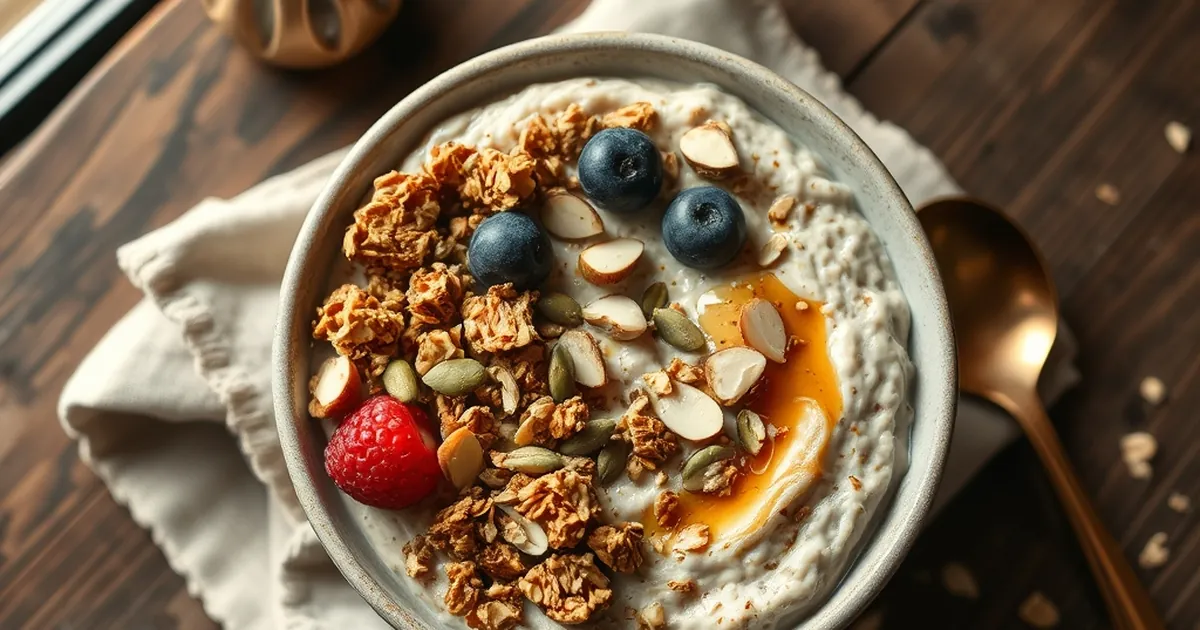
Why does a bowl of oatmeal with toasted seeds and crisp apple feel more satisfying than a silky-smooth purée of the same ingredients? The question isn't just culinary. It's about how texture shapes perception, and how the small crunch at the top of a café oat bowl might be doing more psychological work than we give it credit for.
The Mouthfeel Gap Between Smooth and Crunchy
Walk into any specialty café in Portland or Austin and you'll see the same bowl: a base of steel-cut oats, a swipe of nut butter, a scatter of granola, maybe some cacao nibs. The smooth part is the foundation. The crunchy part is the event.
That distinction matters more than most menus admit. Researchers who study food texture have found that we don't just taste flavor — we taste contrast. A 2016 study in the Journal of Texture Studies found that participants rated foods with mixed textures as more complex and more enjoyable than uniform ones, even when the flavor profile was identical. The crunch isn't decoration. It's information.
Variable-Ratio Reinforcement at the Breakfast Table
Here's where behavioral psychology walks in. B.F. Skinner's work on variable-ratio reinforcement showed that unpredictable rewards — the kind that don't arrive on a fixed schedule — produce the most persistent behavior. You don't know which spoonful will have the big cluster of granola. You don't know which bite will crack with cacao. That uncertainty keeps you engaged.
This isn't a manipulation. It's an honest feature of how attention works. A uniformly smooth bowl delivers the same reward every time, and the brain habituates fast. A bowl with scattered crunch resets the palate with every bite. The reward loop stays open a little longer.
Loss Aversion and the Last Bite
Kahneman and Tversky's loss aversion principle applies here too, though in a gentler register. If the crunchy topping is finite — and it is — you're aware of it diminishing. That awareness makes each remaining cluster feel slightly more valuable. The smooth base never runs out. The crunch does. That asymmetry is why people scrape the edges of the bowl.
What a Café in Minneapolis Got Right
A small café in Minneapolis started offering its oat bowl with a side dish of toasted buckwheat groats, meant to be added spoonful by spoonful rather than dumped in. Regulars reported the bowl felt "bigger" and "more filling" even though the calorie count was identical to the pre-mixed version. The owner told me the side dish cost almost nothing and cut waste, because people stopped leaving half-eaten bowls behind.
That's not a gimmick. That's a design decision rooted in how we actually eat: with our hands, our ears, and our sense of what's left.
Risk, Play, and the Crunch You Choose
There's a competitive element to texture too. Choosing the crunchy add-in is a small act of risk. Will the seeds be too bitter? Will the apple overwhelm the oats? That low-stakes uncertainty is the same mechanism that makes games engaging — not the outcome, but the moment before it. A café bowl lets you play with that mechanism in a setting where the worst case is a slightly weird breakfast.
Where This Goes Next
Cafés are already experimenting with texture layering: freeze-dried fruit that shatters, puffed rice that pops, cold cream against warm oats. The next step isn't more flavor. It's more sequence. Menus that let you build crunch in stages, or that pair a smooth base with three distinct toppings, are already testing better in focus groups than their single-texture counterparts.
If you're running a café, stop thinking of the crunchy topping as a garnish. Treat it as the part of the bowl that does the psychological work. If you're eating one, notice how you ration the crunch. That instinct is older than the menu.