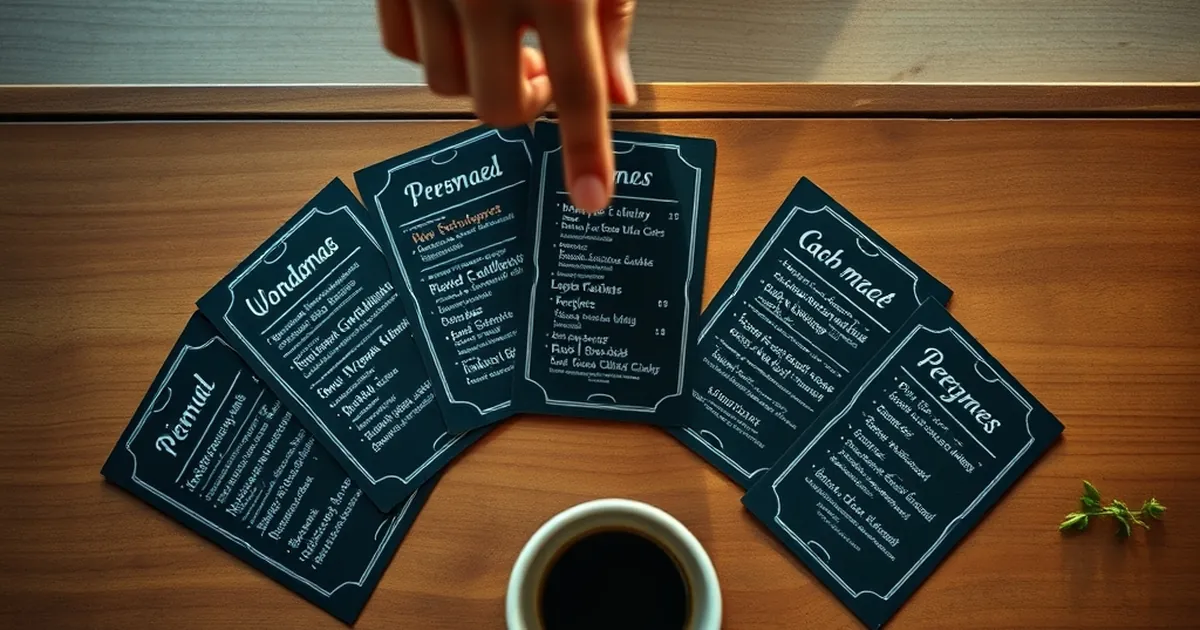
You're standing in line at a café, and the menu board has thirty items on it. By the time you reach the register, you've stopped reading and just point at whatever's closest. That moment—where choice turns into surrender—is the question worth sitting with. Is there a number of options past which our brains simply stop cooperating, and if so, what does that mean for how we feed ourselves?
The Seven-Item Wall
There's a well-worn piece of consumer psychology that says somewhere around seven options, people start feeling the cost of choosing more than the reward. The number itself is squishy—some studies point to five, others to twelve—but the pattern holds: as options multiply, satisfaction with whatever you pick goes down, even when the options are good.
The classic demonstration is Sheena Iyengar and Mark Lepper's 2000 jam study. Shoppers at an upscale grocery store encountered either 24 varieties of jam or 6. The bigger display drew more attention—60 percent of passersby stopped versus 40 percent. But here's the twist: only 3 percent of people who saw the 24-jam display actually bought a jar, compared to 30 percent who saw the 6-jam display. More choices, more browsing, far less buying. The abundance was attractive and paralyzing at the same time.
Why the Brain Buckles
Behavioral economists have a name for the friction: choice overload. It's not that we're lazy. It's that every option we evaluate consumes working memory, and working memory is finite. By option eight or nine, we're not comparing quality anymore—we're just trying to make the discomfort stop.
Daniel Kahneman's work on System 1 and System 2 thinking helps explain the split. Fast, intuitive System 1 can handle a handful of comparisons. Slow, effortful System 2 is what kicks in when the menu gets long—and System 2 is expensive. It burns glucose, it tires quickly, and it's the reason a decision made at 12:30 p.m. feels harder than the same decision at 9 a.m.
There's also a reward-loop angle. When we finally choose, we get a small hit of relief—not pleasure, relief. That's a subtle but important distinction. Relief-driven eating tends to favor the familiar, the salty, the sweet, the thing we already know won't disappoint. Novelty loses to certainty when the brain is tired.
What This Looks Like at the Counter
Watch what happens at a café with a sprawling menu. Regulars order the same thing every time—not because they lack curiosity, but because they've learned that deciding costs more than it delivers. Newcomers freeze, ask the barista what's good, and then order that. The barista becomes a decision-making prosthetic.
This is loss aversion in a small, edible form. A wrong choice feels worse than a right choice feels good. So we narrow the field ourselves, often badly—defaulting to the first thing we saw or the cheapest thing on the board, neither of which is what we actually wanted.
Designing Around the Fatigue
The forward-looking move isn't to demand fewer options everywhere. It's to restructure how options are presented. Group them. Six categories of four beats twenty-four in a row. Lead with three recommendations and let the rest live on a secondary board. Put the seasonal items first, when attention is highest.
For anyone running a café—or just trying to eat better—the lesson is the same: choice is a resource, and it depletes. Spend it on the decisions that matter, and pre-commit on the ones that don't. Pick your lunch before you're hungry. Order the same breakfast on weekdays. Save the exploration for when you have the mental bandwidth to enjoy it.