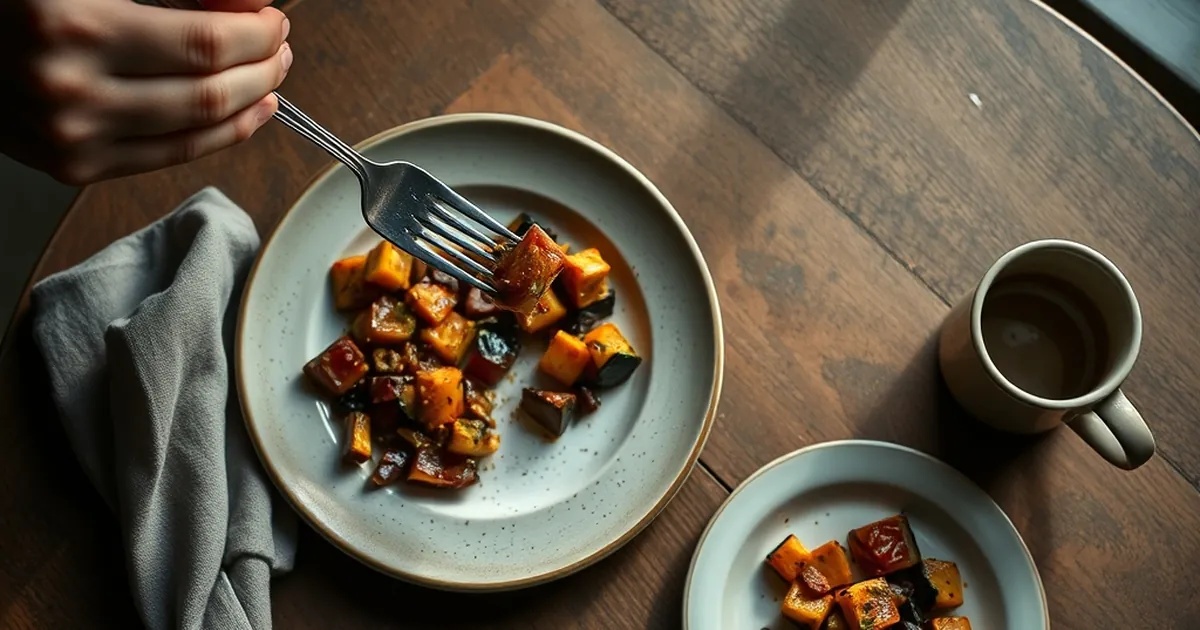
The first thing you taste at a café — a sip of cold brew, a bite of a lemon-poppy scone — does more than wake up your palate. It quietly sets a reference point that every subsequent bite gets measured against, and your brain rarely bothers to tell you it's doing the math. So here's the question worth sitting with: why does the order of what you eat change how much you enjoy the rest, and how much you end up spending to chase that first impression?
The Anchoring Effect, Served Warm
Behavioral economists have known for decades that the first number you see disproportionately shapes every judgment after it. Kahneman and Tversky's work on anchoring showed that even random, irrelevant numbers pull our estimates toward them. Taste works the same way. A bright, acidic first bite establishes a baseline of "this is what good tastes like right now," and your next bite of something richer reads as heavy by comparison — not because it changed, but because the anchor moved.
This is why a well-built tasting menu opens light and builds. It's also why a pastry case arranged with the sweetest item first can make a plain croissant feel like a letdown.
Variable Rewards Keep You Ordering
B.F. Skinner's variable-ratio reinforcement schedule — the finding that unpredictable rewards produce the most persistent behavior — shows up in café lines more than anyone likes to admit. If the cold brew is reliably great, you order it, you enjoy it, you move on. If it's sometimes transcendent and sometimes just fine, your brain keeps pulling you back to find out which one today is.
That unpredictability is a feature of good cafés, not a bug. Seasonal menus, rotating single-origin beans, a barista who adjusts a recipe — these create the kind of small variance that keeps a habit alive without tipping into frustration.
Loss Aversion at the Counter
Kahneman's other famous finding — that losses feel roughly twice as painful as equivalent gains feel good — explains a specific café behavior: the reluctance to try something new once you've found a favorite. You're not just weighing "this might be better." You're weighing "this might be worse, and I'll have wasted the money and the moment."
A concrete example: a regular who always orders the same oat milk latte will often stand in a longer line rather than risk an unfamiliar drink at a shorter one. The potential loss of a bad $6 drink outweighs the potential gain of a great one. Cafés that offer a small free sample of a new drink are quietly working against this bias — removing the downside so the upside can actually compete.
Decision Fatigue Is Real by 3 PM
The average person makes hundreds of food-related micro-decisions a day, and the quality of those decisions degrades as the day wears on. A café that presents twelve syrup options at 7 AM is asking for a clear choice. The same café presenting twelve options at 3 PM is asking for a coin flip — or for the customer to default to whatever they ordered last time.
The practical takeaway for anyone running a counter: shrink the menu when willpower is low. Fewer choices, better defaults, and a clearly marked "if you're not sure, start here" option all reduce the cognitive tax of deciding.
What to Do With This Tomorrow
Next time you're at a café, try deliberately ordering the lighter, brighter item first — a citrus-forward tea, a fruit-forward pastry — and notice how the second item reads. Then try the reverse. The difference you taste isn't in the food. It's in the anchor.
For café owners, the forward-looking move is to treat the first bite as a design decision, not an accident. What you lead with shapes what everything after it is worth. And for the rest of us, the useful skill isn't avoiding these biases — it's noticing when the first sip is quietly setting a price the rest of the meal has to pay.