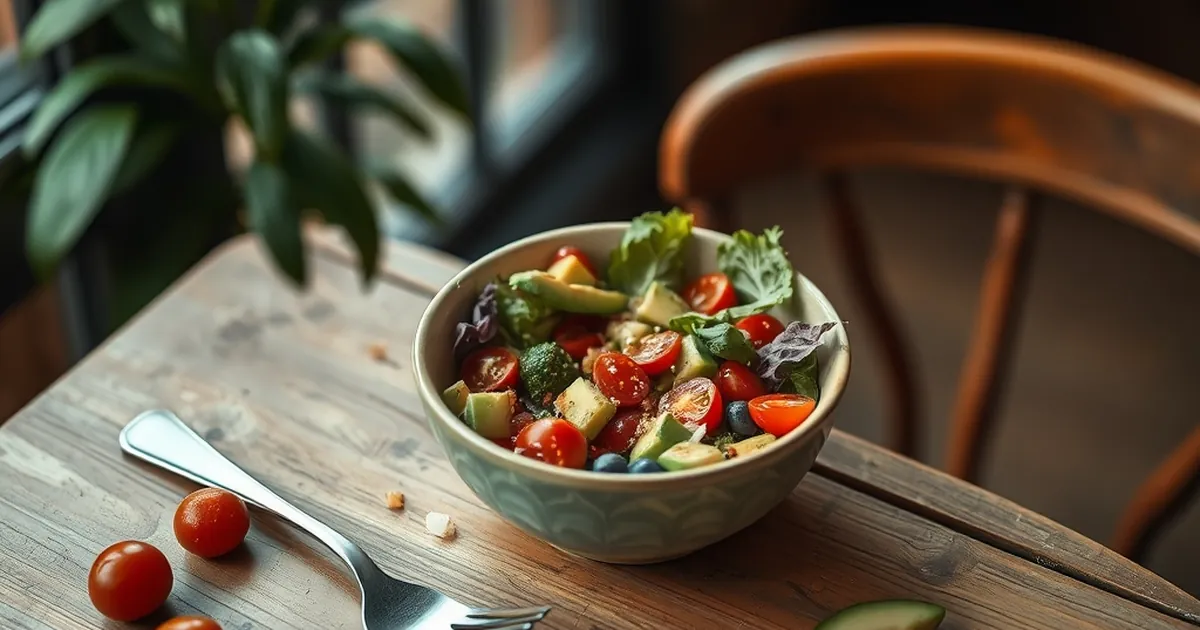
You know that moment about five bites into a really good salad when you suddenly realize you're just... chewing? The flavor that made you close your eyes at bite one has gone quiet, and your fork is moving on autopilot. So what happened between bite one and bite five — and why does it matter for how we eat?
Your Brain Is a Novelty Detector, Not a Flavor Recorder
Taste doesn't work like a camera. It works like a change detector. Your sensory system is built to flag what's new and let what's constant fade into the background — the same reason you stop feeling your socks by mid-morning.
Behavioral scientists call the food version of this sensory-specific satiety. First described in the 1980s by researchers including Barbara Rolls, it's the finding that the pleasure you get from a specific food drops off fast as you keep eating it — often within just a few bites — while your liking for other foods stays intact. That's why you can be "full" of salad and still say yes to dessert. Different stimulus, fresh signal.
So bite five isn't a failure of the salad. It's your nervous system doing exactly what it evolved to do: stop spending attention on something that's no longer changing.
The Reward Loop You Didn't Know You Were In
Here's where it gets interesting for anyone who cares about eating well. The first bites of a great salad deliver a real reward — acid, salt, fat, crunch, a hit of sweetness from a roasted carrot. That's a spike.
Then the spike flattens. And what does a brain do when a reward flattens? It goes looking for the next spike. This is the same machinery behind variable-ratio reinforcement — the pattern where unpredictable rewards produce the most persistent seeking behavior. You don't need a laboratory to see it. You just need to watch yourself eat the croutons first and then pick through the greens.
The trap isn't that salad is boring. It's that we build salads for the first three bites and then blame ourselves for losing interest at bite six.
Loss Aversion Shows Up on Your Plate
Kahneman and Tversky's work on loss aversion — the finding that losses feel roughly twice as bad as equivalent gains feel good — has a quieter cousin at the table. Once you've had a great bite, the next bite is measured against it. A slightly less vivid bite registers as a loss, not a neutral event. Your baseline keeps resetting upward.
This is why the last third of a meal so often feels like a chore even when the food is objectively good. You're not comparing bite ten to hunger. You're comparing bite ten to bite one.
Cooking for Bite Ten, Not Bite One
Restaurants solve this with contrast and pacing — a crunchy element held back, a sauce added late, a textural shift mid-plate. Home cooks can do the same thing without any extra skill:
- Layer textures separately. Keep the toasted seeds, the crispy chickpeas, or the shaved fennel on the side and add them in stages.
- Change the temperature. A warm roasted vegetable against cold greens resets the signal.
- Split the dressing. Half now, half when you're halfway through.
- Add a sharp accent late. A squeeze of lemon at bite seven tastes like a different salad.
None of this is about tricking yourself. It's about respecting how attention actually works instead of pretending willpower will carry you through a bowl of undifferentiated greens.
What to Try This Week
Pick one salad you make often and rebuild it as two or three mini-courses instead of one static bowl. Notice where your attention drops, and treat that as data rather than a character flaw. The goal isn't to stay thrilled for forty bites — it's to design meals that keep offering your brain something to notice, so eating well stops feeling like a test of discipline and starts feeling like something you actually want to finish.