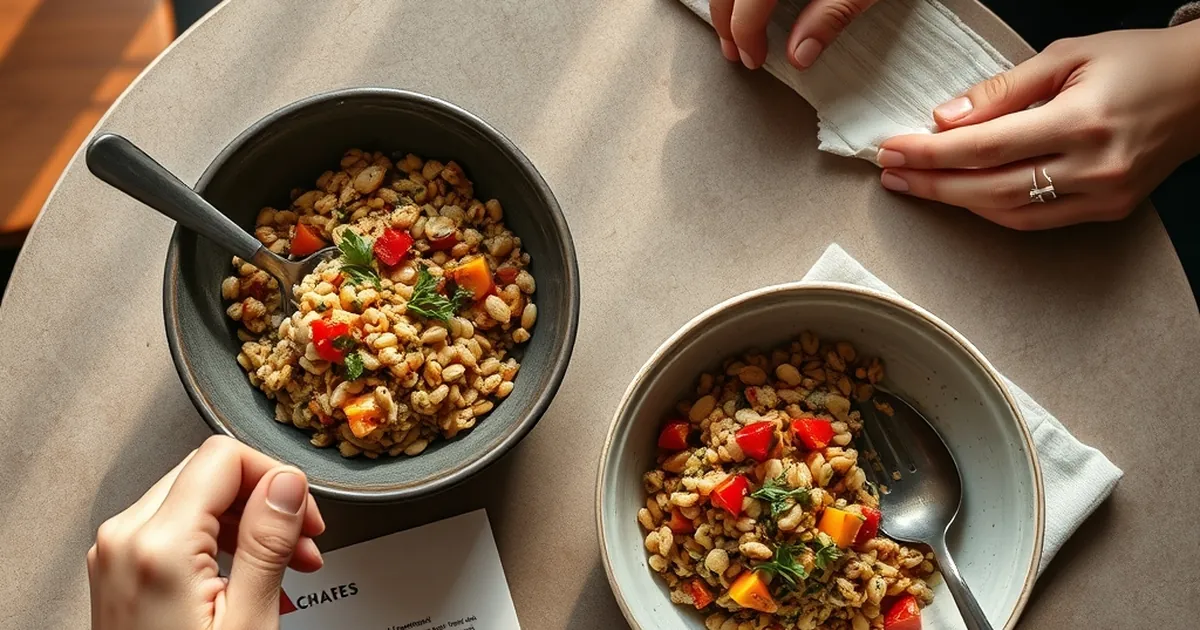
You've probably done it: stood in line at a café you were excited to try, scanned a menu of a dozen intriguing options, and ordered the exact bowl you get every time. Why does the unfamiliar choice so often lose? The answer has less to do with the food than with how our brains weigh what we might lose against what we might gain.
The Menu Is a Bet You Don't Notice You're Making
Every order is a small decision under uncertainty. You can't taste before you commit. Behavioral economists call this a choice under risk, and the research on how people handle it is remarkably consistent. In Kahneman and Tversky's classic work on loss aversion, losses loom roughly twice as large as equivalent gains. Applied to lunch, that means a disappointing new dish stings about twice as much as a great new dish delights.
So the math in your head quietly favors the known. The bowl you've had before has a predictable payoff. The intriguing farro salad is a gamble with a real chance of regret — and regret, as Kahneman's work on regret theory suggests, is a loss you feel more keenly than a missed opportunity.
Reward Loops Keep the Safe Order Feeling Earned
There's a second force at work: the reward loop. When you order the familiar bowl and it delivers, you get a small, reliable hit of satisfaction. That predictability is its own reward, and it reinforces the habit. Psychologists describe this as a reinforcement schedule — the more reliably a behavior pays off, the more it gets repeated. The familiar order is a steady, low-risk payout.
This is also why "I'll branch out next time" is such a common promise. The intention is real, but the moment of ordering re-runs the same calculation, and the safe option wins again.
The Two-in-Three Number Is About Regret, Not Pickiness
If two of three diners reorder the same bowl, that's not a lack of curiosity. It's a rational response to a menu where the downside feels twice as heavy as the upside. The same pattern shows up far beyond cafés — in investing, in product choices, in how people stick with defaults. The café is just where we notice it most.
Making the New Bowl Feel Safer
The fix isn't willpower. It's changing the shape of the decision. A few things actually work:
- Sample first. A taste removes the uncertainty that fuels loss aversion. Many cafés will hand you a spoonful if you ask.
- Order the new thing as a side. A small portion caps the potential loss while still letting you try something.
- Frame the downside honestly. Ask yourself: if this bowl is mediocre, what's the real cost? Usually a few dollars and a mildly disappointing lunch — not a catastrophe.
- Go with a friend who orders differently. Sharing turns a solo gamble into a low-stakes comparison.
The next time you're at the counter, notice the calculation happening. You're not indecisive — you're weighing losses against gains, just like the research says. The question worth asking isn't whether the new bowl might disappoint, but whether the familiar one has stopped teaching you anything. Order the farro salad. Worst case, you learn something about your palate. Best case, you find the bowl you'll be reordering for the next two years.