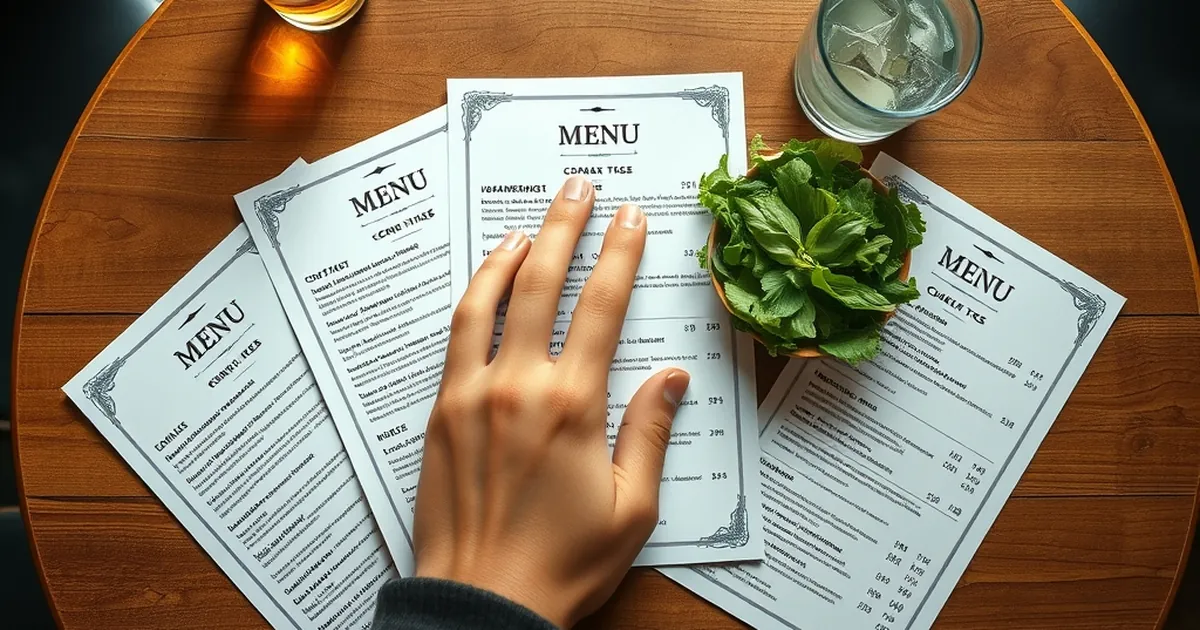
Why does the third item on a menu so often end up in front of you? Not because it's the best thing on the list, necessarily — because of where it sits and how the other items around it frame your choice. There's a real behavioral story here, and it's less about what you crave than about how you decide.
The Setup: Menus Are Built to Make You Compare
A menu isn't a list. It's an argument. Every item is positioned relative to its neighbors, and your brain reads the whole page as a set of trade-offs rather than evaluating each dish on its own merits.
Restaurant consultants have known this for decades. The item in the middle of a three-item cluster tends to get picked at higher rates than the same dish placed elsewhere — not because it's better, but because it's the safe middle. It's flanked. It has a cheaper option to its left and a pricier one to its right, and that position gives it a kind of gravitational pull.
This is where loss aversion enters. Kahneman and Tversky's foundational work showed that losses feel roughly twice as painful as equivalent gains feel good. On a menu, the "loss" you're avoiding isn't money in the abstract — it's the regret of ordering badly. You're not maximizing pleasure. You're minimizing the chance you'll wish you'd ordered something else.
The Decoy Effect, Live at Your Table
The classic demonstration is the decoy: add a third option that's clearly worse than one of the other two, and watch the middle option's share climb. Dan Ariely's well-known Economist subscription experiment is the textbook version — a print-only option priced identically to the print-plus-digital bundle made the bundle suddenly look like a bargain.
Menus do this constantly. A $19 entrée looks reasonable next to a $34 steak and a $14 burger. Remove the steak and the $19 plate loses its anchor. Remove the burger and it starts to feel expensive. The dish didn't change. The comparison set did.
Why "Safe Middle" Beats "Best Thing"
Here's the part that's genuinely interesting: the middle isn't just a spatial position. It's a psychological category. When you're uncertain — and at a restaurant you usually are, since you can't taste anything before it arrives — you reach for the option that carries the least social and financial risk.
This is decision-making under uncertainty in its purest form. You have incomplete information, a time constraint, and a mild social cost if your pick disappoints the table. The middle item solves all three at once. It's defensible. Nobody raises an eyebrow at the person who ordered the chicken.
What This Means for Anyone Who Eats Out
The practical move isn't to avoid the middle on principle — sometimes the middle really is the best dish. It's to notice why you're drawn to it. Ask whether you'd order it if it were the only thing on the page. If the answer is no, you weren't choosing the dish. You were choosing the position.
There's a forward-looking angle worth taking seriously, too. As more restaurants move to digital menus and tablet ordering, the framing gets more aggressive — dynamic highlighting, "most popular" badges, suggested pairings that nudge the comparison set in real time. The middle-item effect doesn't disappear on a screen. It gets sharper, because the algorithm can rebuild the cluster around whatever the kitchen wants to move.
So the next time you eat out, try this: read the whole menu, close it, and name the dish you actually want. Then order that. You might find your taste was never the variable — your fear of a bad call was.