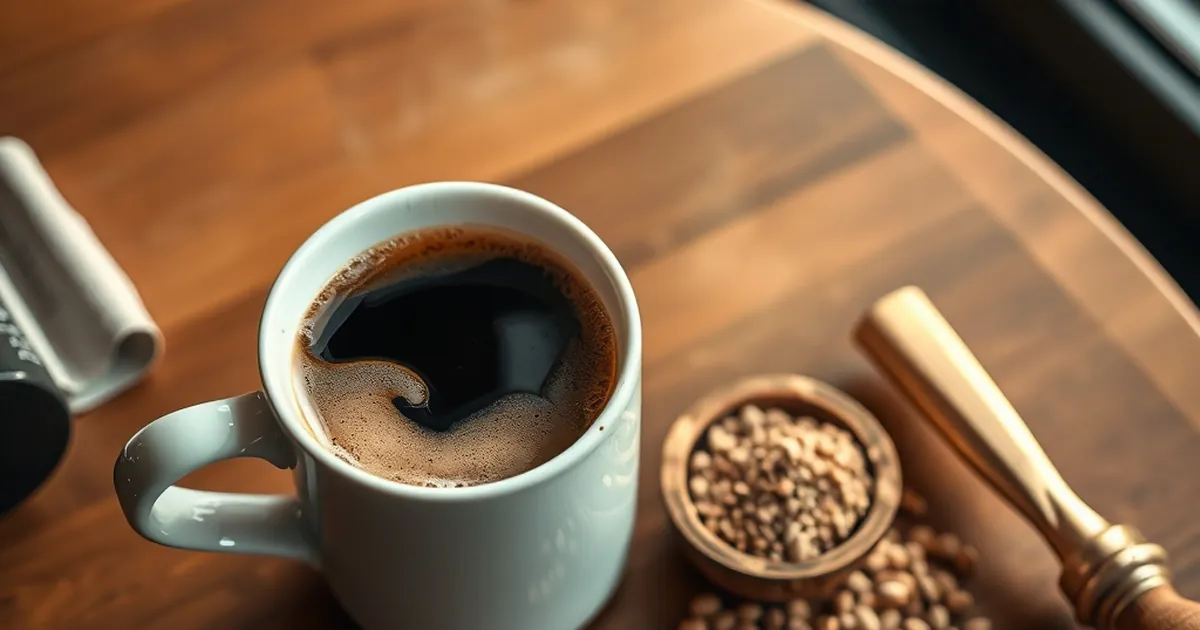
Why does the first sip of coffee feel like a small event, and by the third sip it's just... coffee? The drink didn't change. Your brain did. And that gap between "this is amazing" and "this is Tuesday" is where nutmeg gets weirdly interesting.
Your brain runs on prediction errors, not flavor
Reward learning doesn't work the way most people assume. The brain isn't tracking how good something is — it's tracking how much better or worse it was than expected. Neuroscientists call this a prediction error, and it's the engine behind dopamine signaling. A reward that exceeds expectation produces a spike. A reward that matches expectation produces almost nothing.
This is why the fourth sip of a great latte is less thrilling than the first. Your brain already updated its model. The flavor is identical; the surprise is gone.
Food marketers exploit this constantly. Ever notice how the first bite of a fast-food burger is the best one? That's not nostalgia. It's a prediction error that collapses within seconds.
Variable reward is why the first sip wins
B.F. Skinner's work on variable-ratio reinforcement showed that unpredictable rewards produce more persistent behavior than predictable ones. Give a pigeon a pellet every time it pecks, and it pecks steadily. Give it a pellet on a random schedule, and it pecks like the pellet owes it money.
Coffee sits in a strange middle zone. It's chemically rewarding (caffeine, warmth, ritual), but the sensory experience is fairly consistent. Same beans, same grind, same mug. Your brain learns the pattern fast, and the reward signal flattens.
Nutmeg interrupts that flattening. Not because it's magic — because it's a small, unexpected sensory variable layered on top of a familiar one. The aroma hits before the taste. There's a brief moment where your brain can't fully predict what's coming, and that moment is the reward.
The four-sip window
Here's the practical part. The window where a new flavor element actually changes your experience is short — roughly the first three to five sips of a drink. After that, adaptation kicks in and the addition becomes the new baseline.
So the move isn't "add nutmeg to coffee forever." It's to treat the first few sips as the actual event. Grate nutmeg fresh over the top of a cup — not stirred in, but sitting on the surface where the aroma releases first. Take the first sip before you sit down, before your phone, before the email. Then let the rest of the cup be ordinary.
You're not trying to make coffee better. You're trying to make the first thirty seconds count.
What this has to do with loss aversion
Kahneman and Tversky's work on loss aversion showed that losses feel roughly twice as powerful as equivalent gains. Applied to food, this means a disappointing sip registers harder than a good one. Which is why so many people describe their morning coffee as "fine" — they've stopped noticing it, and the noticing itself was the pleasure.
Adding a variable isn't about chasing novelty. It's about restoring the contrast that made the drink worth paying attention to in the first place.
Where to take this next
Try it with something other than nutmeg. A pinch of cardamom. A strip of orange peel. A different mug. The specific ingredient matters less than the structure: a small, predictable unpredictability at the start of a routine you've stopped tasting.
Then watch what happens to the rest of your morning. The same trick that resets a coffee reward loop tends to reset other loops too — the ones you didn't notice you were running.