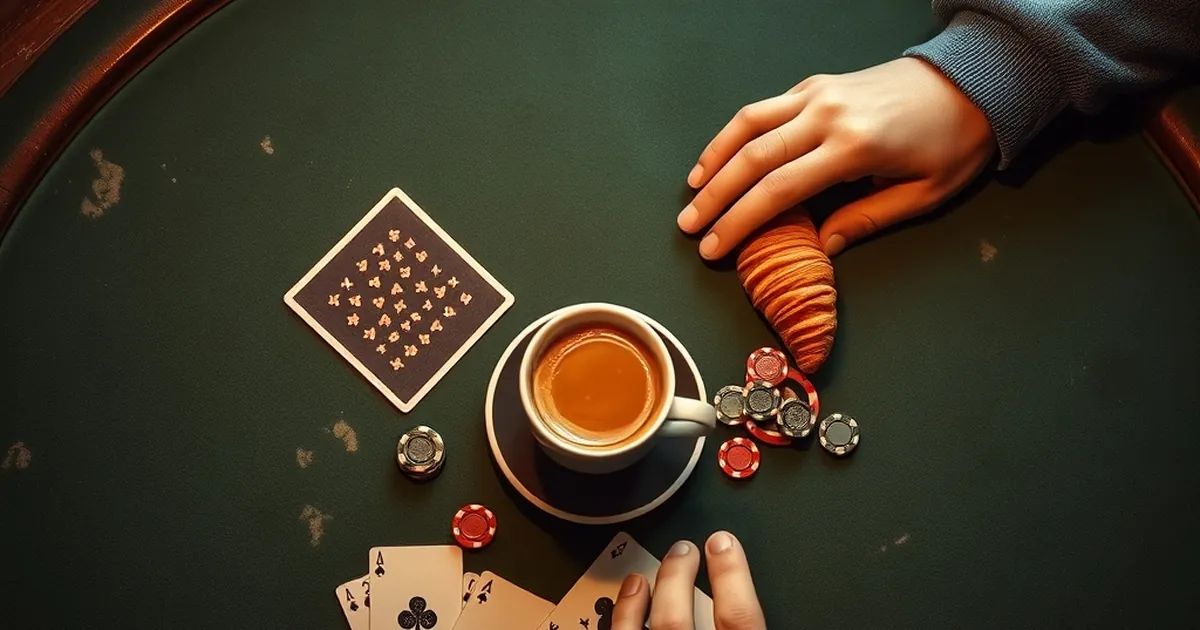
Most players think a tell is something you catch mid-hand—a shaky bet, a staredown, a chip stack fumbled on the river. But the useful information usually shows up earlier, in the sixty to ninety seconds before the first card comes off the deck. How someone sits, orders, stacks, and talks during the dead time is a cleaner signal than anything they do with money on the line, because there's nothing to protect yet.
The pre-hand window is the honest window
Watch a table for twenty minutes and you'll notice the same people do the same small things every orbit. That repetition is the tell. A single gesture means nothing; a baseline you can measure against means everything.
The reason is simple: during a hand, players are actively managing their image. Before the deal, most aren't. They're scrolling a phone, arguing about a bad beat, or counting chips for the next buy-in. Guard down, habits up.
What to actually log
- Seat posture. Does the player lean in when they're about to play, or only after they've looked? Leaning in before the deal suggests they've already decided to enter the pot.
- Chip handling. Someone who shuffles a single stack all night and suddenly stops is doing math—or deciding.
- Speech volume. The loudest guy at the table usually goes quiet when he's involved. Quiet players get chatty when they're folding.
- Phone behavior. A player who puts the phone face-down and squares up to the table is signaling intent more reliably than any physical twitch.
The one number that matters
In live no-limit hold'em, you'll see roughly 25 to 30 hands per hour at a full ring game. That's the cap on your sample. If a tell only fires once every 40 hands, you don't have a read—you have a coincidence. This is why pre-hand observation beats in-hand observation: you get a data point every single hand, not just the ones you're involved in. Over a four-hour session, that's 100 to 120 pre-hand observations versus maybe 15 contested pots. The math favors the boring stuff.
Why physical tells get overrated
Televised poker taught a generation to look for the trembling hand. But the WSOP main event final table is a terrible classroom—those players have been on camera for two weeks and know exactly what their hands are doing. In a $1/$2 game at a local room, nobody's rehearsed.
Two caveats worth keeping:
- Tells are population reads, not individual ones. A nervous bettor at a low-stakes table is more likely strong than bluffing, because most recreational players bet bigger when they like their hand. That's a tendency, not a law.
- Reverse tells exist. Experienced regulars know you're watching the pre-hand routine and will deliberately break it. If someone changes their ritual only when you're looking at them, that's the actual information.
The uncomfortable implication
If the best reads happen before the cards, then the most valuable skill at the table isn't hand reading—it's attention. And attention is exactly what phones, headphones, and table talk are designed to break.
Which raises a question worth sitting with: if you're playing four tables online while watching a stream, what are you actually observing? Nothing. The pre-hand window doesn't exist on a screen, and neither does the edge that comes with it. The players who still win live are the ones who never stopped watching the room—and if that sounds like too much work for a Friday night, that's a fine reason to set a loss limit and treat it as entertainment instead.