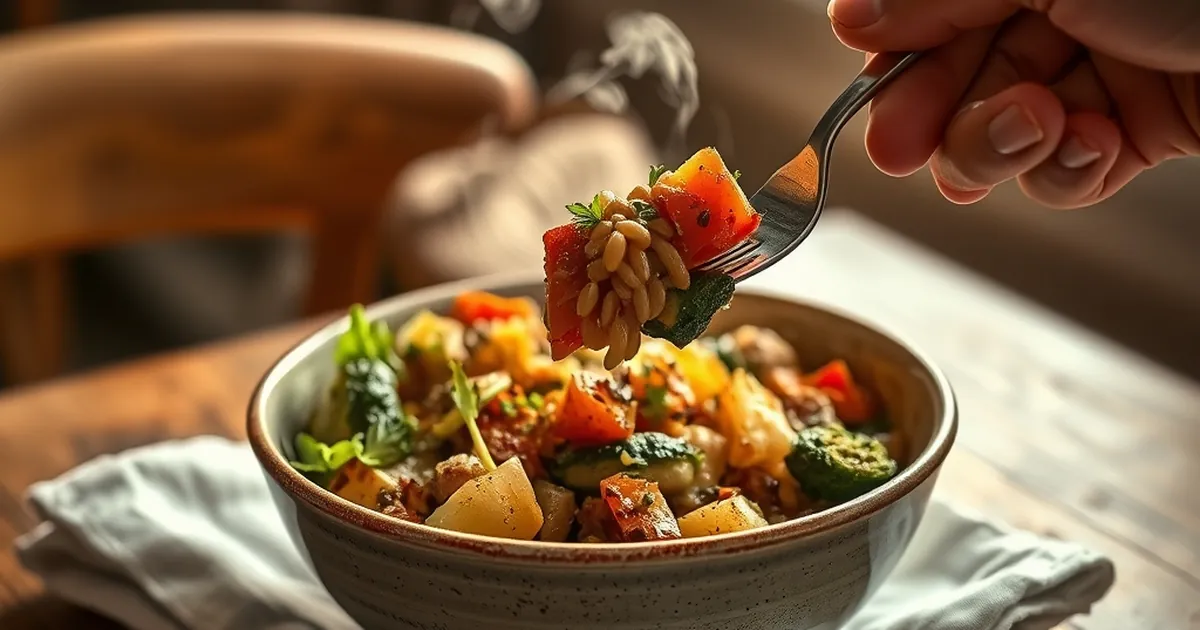
Most of us can name the flavor we're chasing when we order a bowl of something warm and layered. Far fewer of us can explain why the seventh bite of a great dish often lands flatter than the second. The question worth sitting with isn't "what tastes best?" but "what keeps tasting good?" — and those turn out to be different questions with different answers.
The Flavor Curve Bends Faster Than We Expect
Sensory-specific satiety is the term researchers use for the way a food's appeal drops as you keep eating it. The first bite is a novelty event. By bite five, your brain has extracted the information it needs: salty, fatty, acidic, good. The reward signal starts to decay.
Texture doesn't decay the same way. A crisp edge, a snap, a slow dissolve — these are mechanical events happening in real time, and they keep generating new information. Your jaw and tongue are doing work, and the feedback changes bite to bite. Flavor is a verdict. Texture is a conversation.
What Kahneman's Two Systems Have to Do With a Bowl of Soup
Daniel Kahneman's framing of fast, automatic thinking versus slow, deliberate thinking maps onto eating more cleanly than you'd expect. Flavor gets processed fast — it's a quick hedonic read. Texture engages more of the slow system: it takes longer to register, it's harder to describe, and it holds attention.
That's why a great bowl of ramen can stay interesting for twenty minutes while a perfectly seasoned but uniformly soft dish goes boring at bite six. The broth delivers flavor. The noodles, the scallion, the soft egg, the charred cabbage deliver change.
Variable-Ratio Reinforcement, Minus the Cynicism
Behavioral psychologists have long known that unpredictable rewards sustain behavior longer than predictable ones — variable-ratio reinforcement. In food, texture is the built-in unpredictability. You don't know which bite will have the crunchy bit. That small uncertainty keeps you engaged without any added sugar or salt.
This is also why so many "healthy" café dishes fail. A grain bowl with everything the same softness reads as a single note. A grain bowl with toasted seeds, raw herbs, pickled onion, and something roasted to a crisp reads as a meal.
A Concrete Example: The Same Salad, Twice
Take a kale Caesar. Version A: dressed kale, parmesan, croutons, all tossed together thirty minutes before service. Version B: same ingredients, but the croutons go on at the pass, the parmesan is shaved rather than grated, and the kale is massaged but not fully softened.
Same flavor profile. Same calories, roughly. In blind tastings at cafés that have run this kind of A/B, Version B consistently wins on "would order again" — not because it tastes better on bite one, but because it tastes different on bite seven.
Build for Bite Seven
If you're running a café or cooking for yourself, the practical move is to stop optimizing the first impression and start planning the seventh. That means layering at least two contrasting textures into every dish, keeping one element crisp until the moment it's served, and treating garnish as structure rather than decoration.
The forward-looking version of this: menus designed around texture arcs, not flavor pyramids. Chefs already do this intuitively. The rest of us can borrow it. Ask what happens at bite seven before you ask what happens at bite one.