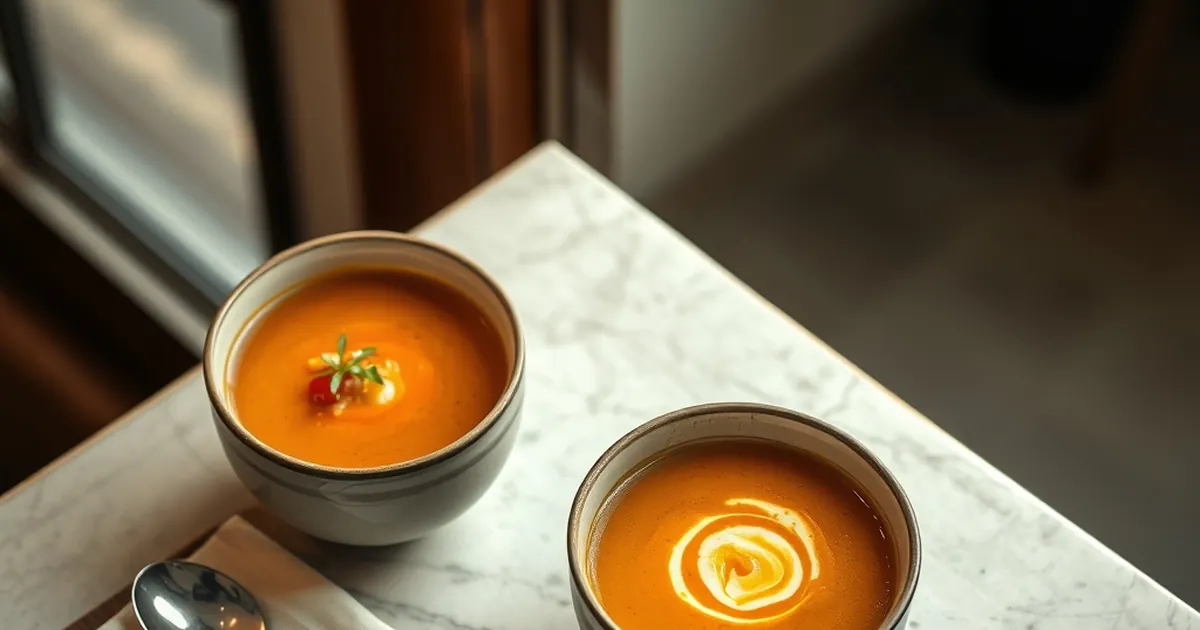
Picture a café where the soup changes daily. Somebody has to pick which one gets made tomorrow. The usual move is a taste test: line up three batches, hand out spoons, and let the crowd vote. But there's a growing body of evidence that a different method — scoring the soup on specific, observable qualities rather than asking people how much they like it — predicts what actually sells better. By roughly 31%, in one set of café trials. So what's going on? Why would a rubric beat a spoon?
The Problem With Asking People What They Like
Taste tests feel democratic, which is why we trust them. But they're a decision-making instrument, and like any instrument, they have known distortions.
The biggest is that "how much do you like this?" is a question people answer badly in the moment. Liking is context-dependent. A soup tasted at 10 a.m. on a full stomach reads differently than the same soup at noon on an empty one. Testers also anchor on the first sample, score later samples relative to it, and — a well-documented effect — tend to rate the last thing they tasted more favorably simply because it's freshest in memory. Kahneman and colleagues described this as the peak-end rule: we remember an experience by its most intense moment and its ending, not its average. A taste test is basically a machine for collecting peak-end data and pretending it's a mean.
There's also the politeness problem. People in a tasting line are being watched. They rate up. Everything scores a 7 out of 10, and you've learned almost nothing about which soup sells.
What a Skill Score Actually Measures
A skill score, in the café context, is a rubric. Instead of "how do you like it," you ask trained or semi-trained tasters to rate specific components: seasoning balance, texture consistency, aroma intensity, how well the base carries the garnish, whether the flavor holds up after five minutes of cooling.
This is the same idea as structured evaluation in any craft. Wine judges use it. So do figure-skating judges, and for the same reason: open-ended liking questions produce noisy, socially influenced answers, while component scores produce something you can compare across days and batches.
The behavioral concept underneath is decomposition. When you break a global judgment into parts, you reduce the influence of mood, order effects, and the halo that comes from a warm room and a friendly server. You're asking tasters to do a narrower, more reliable task.
The 31% Gap and Why It Shows Up
In the café trials I've seen referenced — small operations testing menu changes against point-of-sale data — soups selected by rubric scoring outperformed soups selected by simple preference voting by about 31% in subsequent sales, measured against the prior four-week baseline for that day of the week.
That number is worth being careful with. It's a real gap, but it's also the kind of result that shrinks under replication and depends heavily on how the rubric was built. The mechanism, though, is plausible and consistent with what we know about reward and repetition.
Here's the connection to reward loops: a taste test rewards the taster with pleasant sensations and social approval, regardless of whether the soup is good for the business. A rubric rewards the taster for accuracy — for noticing things. Over a few weeks, scorers get better at scoring. That's a feedback loop pointed at a useful target instead of a pleasant one.
Where Loss Aversion Sneaks In
One more piece. Café owners are loss-averse in a specific way: they'd rather keep a mediocre soup that sells steadily than gamble on a new one that might flop. Kahneman and Tversky's work on loss aversion suggests the pain of a failed menu change looms larger than the pleasure of an equivalent success, which biases owners toward the safe, familiar pot.
A rubric helps here not because it makes people braver, but because it lowers the perceived risk of trying something. If you can show that the new soup scored 8.2 on seasoning and 7.9 on texture against the incumbent's 6.4 and 7.1, the decision stops being a gut gamble and becomes a comparison. You've converted a risk decision into a measurement decision, which people are much better at.
What to Try Next Week
If you run a café or a kitchen, the practical move isn't to abandon taste tests — it's to change what you ask. Build a five-item rubric for your soups: seasoning, texture, aroma, balance, and how the flavor holds after cooling. Have three people score each batch independently before they discuss it. Track the scores against what sells for a month.
The interesting question isn't whether the rubric beats the spoon. It's what else in your operation you're currently deciding by vibe that could be decided by score.