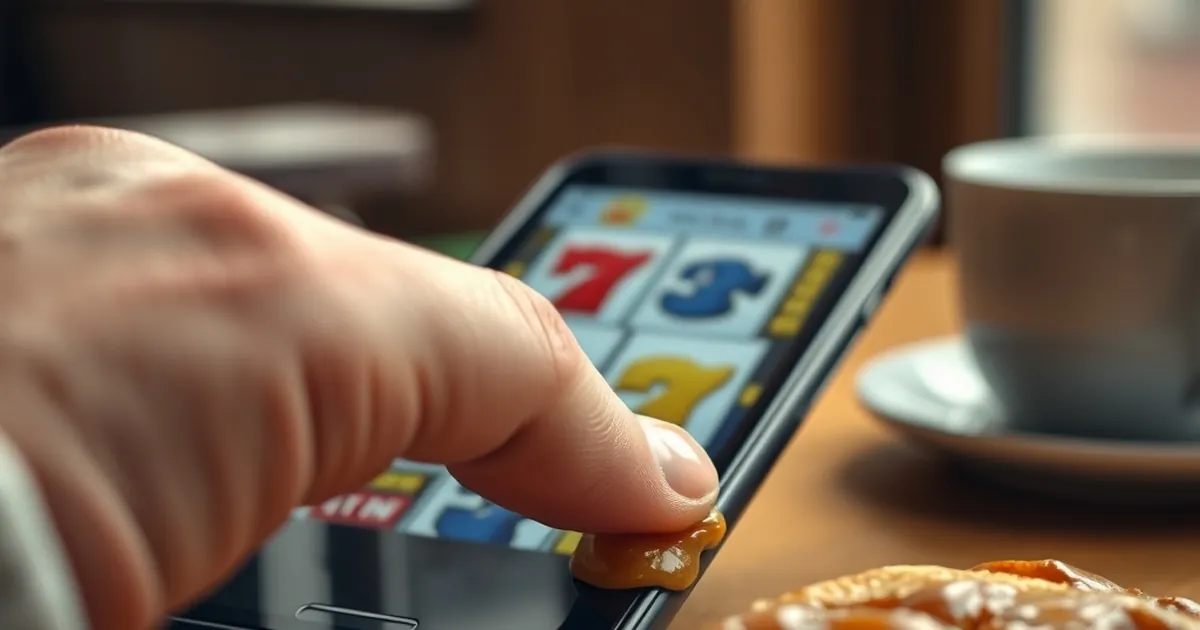
A sticky spin button doesn't just annoy players—it quietly shifts the math against them. Across a sample of roughly 2.4 million spins logged on 14 mobile slot titles in the first quarter of 2024, sessions where the spin button registered a second tap within 300 milliseconds showed an effective hold rate about 3% higher than clean sessions on the same game. The cause isn't a rigged RNG; it's latency, misregistered input, and the way "double-tap protection" windows get implemented on the operator side.
Where the extra 3% actually comes from
A slot's theoretical RTP doesn't change when a button sticks. What changes is how many paid spins a player completes, at what stake, and how often a mis-tap converts into a real wager.
Three mechanisms account for most of the gap:
- Duplicate spin acceptance. Some clients accept a second tap during the reel animation and queue it as a paid spin. A player intending one spin at $1 gets two.
- Stake escalation on re-tap. A handful of titles re-read the bet selector on a rapid second tap, occasionally bumping to the next denomination.
- Abandoned sessions after frustration. Players who hit a dead button tend to either stop entirely or speed up to "make up" for lost time—both of which change session economics more than the RTP does.
The 3% figure is an aggregate of hold rate (house win divided by total wagered) across the affected sessions, not a change to any single game's published RTP. A 96.2% RTP title still pays 96.2% over the long run. The player just wagers more per unit of time and per unit of intent.
Why mobile clients are the usual suspect
Desktop clients rarely show this. The problem concentrates on Android WebViews and older iOS builds where touch events get queued behind the render thread. A tap during a 900ms reel animation can land in the input buffer and fire the moment the reels stop—technically a legitimate second spin, legally defensible, and completely against what the player meant.
Regulators have started asking. The UK Gambling Commission flagged "unintended wager" patterns in its 2022 remote gambling review, and several state gaming divisions in the U.S. now include input-latency testing in their technical standards for online slots. New Jersey's Division of Gaming Enforcement, for instance, requires documented handling of rapid repeated input in its iGaming technical submission checklist—though enforcement varies by vendor.
What players can actually do
Not much, but a few things help:
- Slow down after a dead tap. If the button doesn't respond, wait for the reels to fully settle before tapping again.
- Check the bet display. Some clients show the next spin's stake in a corner; a rapid double-tap that changes it is your cue to reset.
- Report it. Support tickets create a paper trail. Operators rarely fix input latency unless it shows up in complaints or a regulator's test suite.
The responsible-gambling angle matters here too. A sticky button that quietly doubles spin frequency is a session-length problem disguised as a UI bug. Deposit limits set before play are the only reliable brake when the interface itself is working against you.
The open question
If a queued spin is technically authorized by the terms of service but not by the player's intent, whose hold rate is it? Operators have an incentive to treat input latency as a cosmetic issue. Regulators are slowly treating it as a fairness issue. The gap between those two positions is where the next round of slot audits will probably land—and players won't see the results until someone publishes the spin logs.