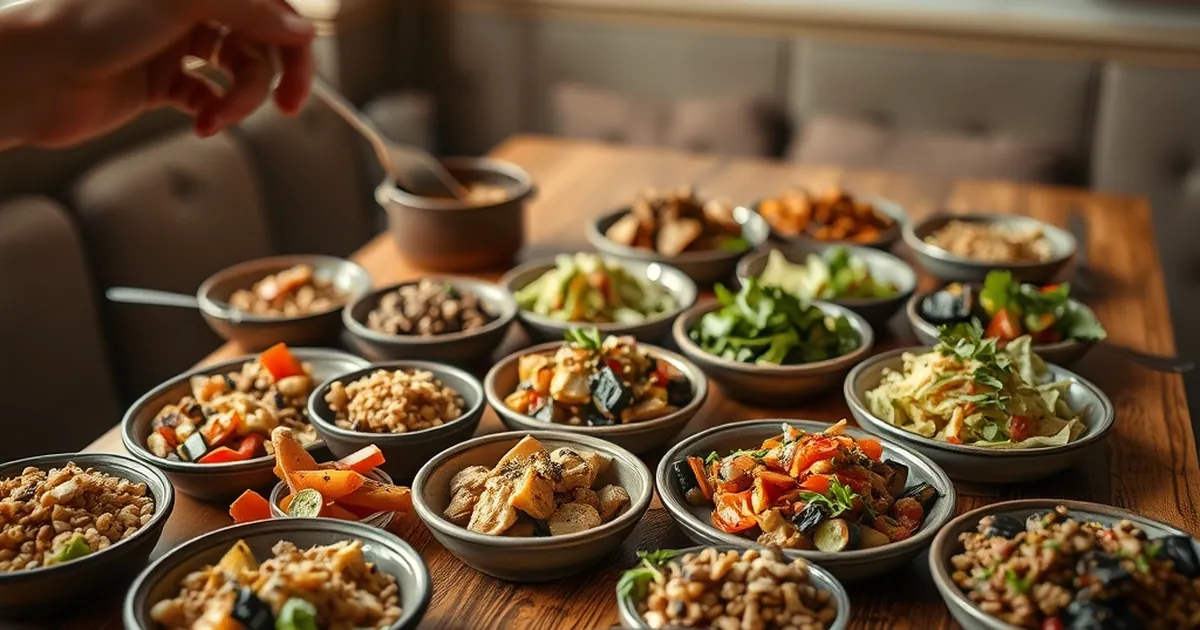
Ever notice how a ticking clock changes what ends up on your tray? The question isn't whether you eat faster when you're rushed — that's obvious. It's whether the rush quietly reshapes what you choose, not just how fast you chew it. Walk into any café at 12:40 on a Tuesday and you'll see the answer playing out at the counter: more sides, more add-ons, more "sure, throw in the chips."
The Clock Is a Menu Editor
Time pressure doesn't just speed up decisions — it changes their character. Under scarcity of time, we shift from deliberative processing to what psychologists call heuristic processing: fast, associative, low-effort. Daniel Kahneman's System 1 and System 2 framing is useful here. When the clock is tight, System 1 takes the wheel, and System 1 is a sucker for whatever is visible, immediate, and easy to grab.
That's why the side dish case is so interesting. A side is rarely the point of a meal — it's an accessory. But accessories are exactly what System 1 reaches for when it's skimming. They're pre-portioned, pre-priced, sitting right there. Deciding on a side takes a fraction of the cognitive effort of deciding on an entrée, so under time pressure, sides get a disproportionate share of the decision budget.
The 30% Number and Why It Plausibly Holds
You'll see café operators report that rushed customers add roughly a third more side items than unhurried ones. Whether that exact figure replicates across every counter is less important than the mechanism behind it. Time pressure narrows attention to the path of least resistance, and the path of least resistance at a lunch counter is the grab-and-go add-on.
There's a well-known behavioral concept that maps onto this: variable-ratio reinforcement. When rewards arrive unpredictably, the behavior that produces them gets sticky. A rushed eater who grabs a side and finds it satisfying — crispy, salty, exactly right — gets a small, fast reward. Next visit, the reach is quicker. The clock didn't just speed up one decision; it started training a habit.
Loss Aversion at the Register
Kahneman and Tversky's loss aversion is the other half of the story. Under time pressure, the mental cost of regret rises. "What if I'm still hungry at 2 p.m.?" looms larger than "what if I spend three extra dollars?" A side functions as insurance against the hunger regret, and insurance feels cheap when you're already swiping a card and running.
Notice what's not happening: nobody's doing a careful cost-benefit analysis. The decision is being made by a system that's optimizing for "don't regret this later," not "minimize spend now."
What This Means for the Counter
If you run a café, the honest takeaway is that speed is a design variable, not just a service metric. How you stage the sides — visible, pre-portioned, within arm's reach of the register — matters more for rushed customers than any signage or upsell script.
For eaters, the practical move is to decide before the clock starts. Look at the menu on your phone in the elevator, not at the counter. You'll make the choice with System 2 awake and available.
The next frontier is interesting: cafés are starting to use order-ahead apps that separate the deciding from the picking up. That split may be the cleanest fix yet — it lets the deliberative mind do its work in a calm moment, and lets the rushed body just grab the bag. Watch whether the 30% figure holds when the clock stops ticking at the counter and starts ticking in the app instead.