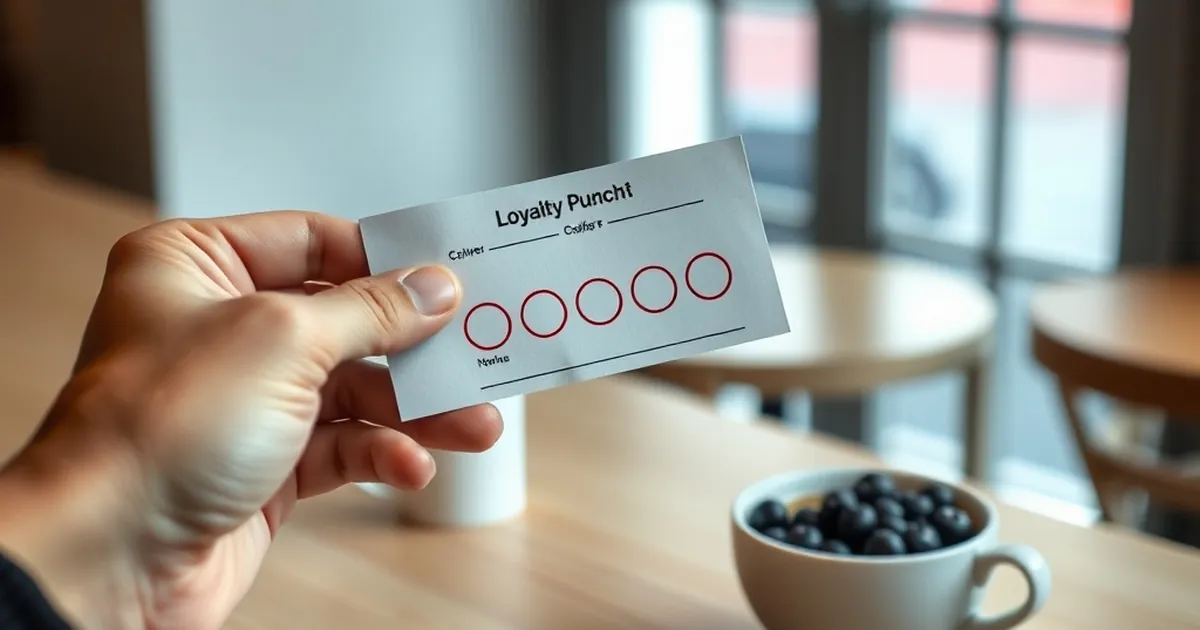
Picture the punch card on your fridge: ten coffees, tenth one free. Now picture the moment you stop caring. It tends to happen around the fourth stamp, not the ninth. Why does a reward system lose its pull right when the finish line starts to look real?
The Fourth Visit Is Where the Story Turns
Café loyalty programs are a small behavioral lab running in public. A regular earns a stamp, feels a flicker of progress, and decides whether to come back. Somewhere in that sequence, the flicker dims.
The pattern shows up in the data cafés already collect. Order frequency climbs steadily through visits one, two, and three. By visit four, the curve flattens. Diners still come, but the incremental lift from the reward itself shrinks. The streak has done its job of forming a habit, and the habit now runs on autopilot rather than anticipation.
This is not a failure of the program. It is a predictable feature of how humans process repeated rewards.
Variable Rewards Beat Predictable Ones
Behavioral psychology has known for decades that unpredictable reinforcement holds attention longer than a fixed schedule. B.F. Skinner's work on variable-ratio reinforcement showed that organisms persist longer when rewards arrive on an irregular basis than when they arrive every single time.
A punch card is the opposite of variable. It is perfectly predictable, which makes it easy to model mentally, which makes it easy to stop thinking about. The tenth coffee is a certainty, and certainty is quiet.
Cafés that introduce small unpredictability—a surprise pastry, a rotating seasonal bonus, a "your next visit might include something extra" note—tend to see engagement hold steadier past the fourth visit. The reward is no longer a transaction. It is a small open question.
Loss Aversion Keeps Streaks Alive Longer Than Gains
Kahneman and Tversky's work on loss aversion established that losses feel roughly twice as painful as equivalent gains feel good. Applied to a café streak, this means a customer with four stamps is more motivated by the fear of losing progress than by the promise of a free drink.
That is why the fourth visit matters so much. By then, the customer has accumulated something. Breaking the streak now costs something real. Cafés that frame loyalty in terms of what the customer has built—"you're four visits into your streak"—tap into that asymmetry. The language shifts from future gain to present ownership.
The Plateau Is Real, and It Is Manageable
A plateau is not a dead end. It is a signal that the reward structure has done its work and needs a new shape.
Consider a café in Portland that noticed its regulars peaked at visit four and then drifted toward the same two or three orders. Instead of adding more stamps to the card, it introduced a rotating "chef's pick" available only to streak holders. Order variety rose, and visit frequency stabilized. The reward changed form without changing size.
That is the practical lesson. When the streak stops moving the needle, change the reward's texture rather than its value.
What to Watch Next
The next frontier for café loyalty is not bigger discounts. It is better-timed surprise. Programs that track individual visit patterns and introduce small, well-placed variations around the fourth visit are already outperforming flat punch cards in early tests.
If you run a café, look at your own data this month. Find the visit number where frequency flattens. That is your fourth visit, whatever the actual number is. Then ask what small, unpredictable thing you could offer there—something that makes the streak feel alive again rather than merely counted.