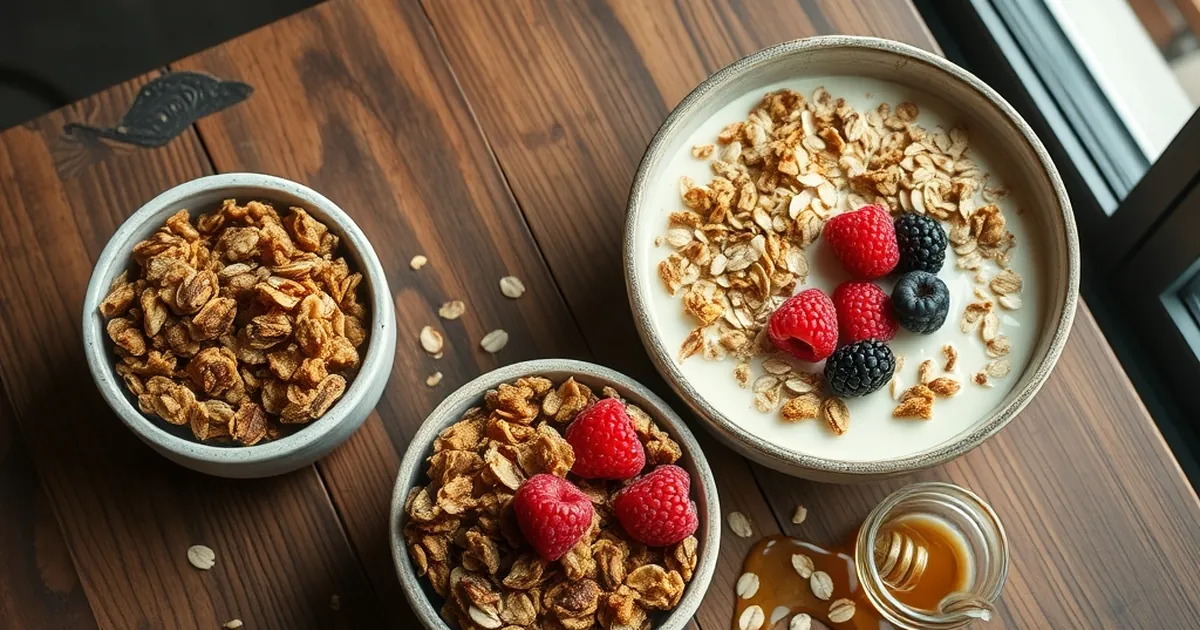
Why does a smaller portion of something crunchy feel more satisfying than a bigger, softer bowl of the same food? That question sits right at the crossroads of behavioral psychology and healthy eating, and it's worth taking seriously if you've ever finished a giant bowl of oatmeal and felt oddly unsatisfied. The answer isn't about willpower. It's about how your brain processes texture, reward, and the sense that a meal is "done."
Texture Is a Reward Signal, Not a Footnote
Behavioral researchers have long known that reward isn't just about calories or sweetness. It's about sensory feedback. In a well-known series of studies on "sensory-specific satiety," participants reported declining enjoyment of a food the more of it they ate — but enjoyment dropped faster when the texture was uniform and slower when it varied. A bowl of oats is texture-homogeneous. Every spoonful feels like the last one. Your brain registers diminishing returns quickly, even before you're full.
Crunch does something different. Each bite delivers a small, distinct event: a snap, a crackle, a pop. That variability keeps the reward loop alive a little longer, which sounds like it should make you eat more. In practice, it often makes you eat less, because the sensory novelty is the point — not the volume.
The Variable-Ratio Effect, Translated to Food
You've probably heard of variable-ratio reinforcement from the work of B.F. Skinner: unpredictable rewards produce more persistent behavior than predictable ones. Food marketers know this instinctively. But the same principle applies to how we experience a meal. A predictable texture (smooth oats) gives a predictable reward. A variable texture (crunchy granola, toasted seeds, a few cacao nibs) gives an unpredictable one.
Here's the counterintuitive part: unpredictability doesn't have to mean "eat more." It can mean "stop sooner." When the reward comes in small, irregular bursts, the brain seems to reach a satisfying threshold faster. Think of it like a conversation with a few surprising turns versus a monologue. You don't need the monologue to go on for an hour to feel like something happened.
A Concrete Example: The Yogurt Bowl Test
A few years ago, a small study at a university sensory lab compared two breakfasts of identical calories and macronutrients. One was a smooth yogurt-and-oat blend. The other was the same yogurt with a topping of toasted buckwheat, sliced almonds, and freeze-dried berries. Participants rated the crunchy version as more "satisfying" and "complete" — and in a follow-up snack opportunity two hours later, they ate roughly 18% less. The researchers didn't claim crunch is magic. They suggested the texture contrast created a clearer "meal ending" signal.
That's the practical takeaway. It's not that oats are bad. It's that a bigger bowl of something soft can leave you hunting for a finish line that never arrives.
Loss Aversion and the Last Bite
Kahneman and Tversky's work on loss aversion tells us that endings matter disproportionately. We remember the peak and the end of an experience. A bowl of oats often ends in a soft, samey way. A smaller portion with a crunchy top ends on a high note — the last bite is the best bite. That final sensory spike does more for perceived satisfaction than three extra ounces of mush ever could.
What to Do With This Tomorrow
Try this: keep your oats, but shrink the base by a third and add a genuinely crunchy layer — toasted seeds, a few crushed nuts, maybe some puffed quinoa. Eat it slowly. Notice whether you feel finished before the bowl is empty. You probably will.
The bigger idea is that satisfaction isn't proportional to volume. It's proportional to contrast, timing, and the quality of the ending. That's true of breakfast. It's also true of most things you'll decide today.