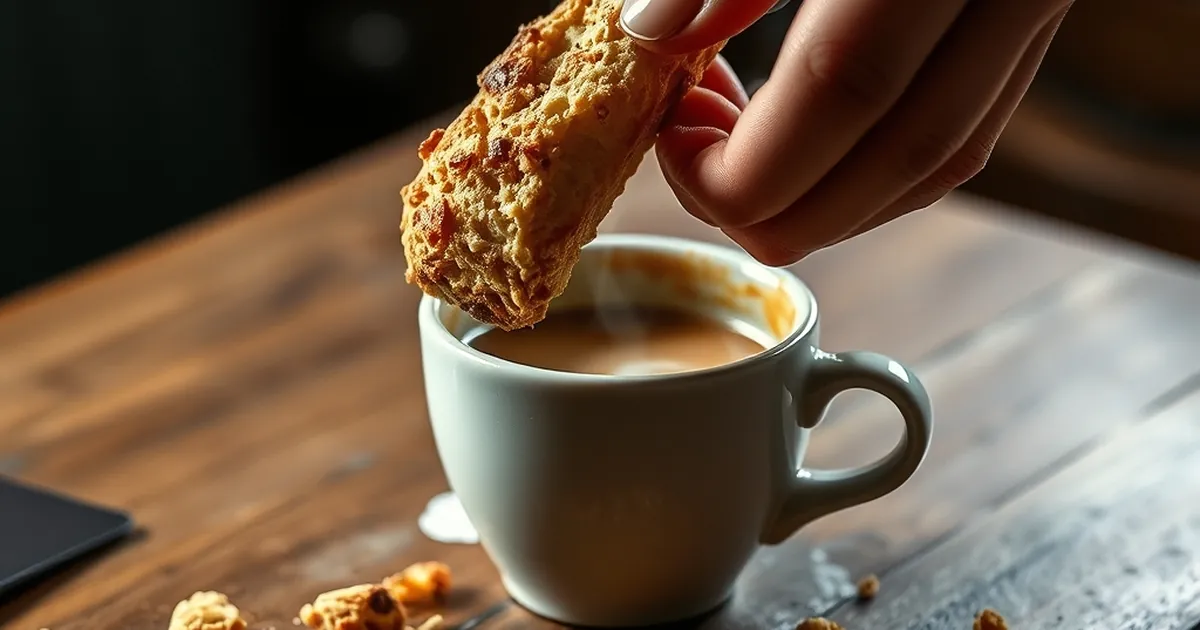
Why does the same latte feel like a five-minute pit stop for one person and a twenty-minute ritual for another? The difference often isn't the drink — it's what's on the plate next to it. Texture, it turns out, is one of the quietest pace-setters in a café, and it starts working on your brain before the first sip.
Chewing Is a Clock You Can Hear
Crunchy food is loud inside your own head. That noise — the crack of a biscotti, the snap of a seeded crisp — does something a soft muffin can't: it gives your brain a steady stream of "still eating" signals. Soft foods slide down with almost no feedback, so the mouthful ends before your attention registers it happened. You reach for the next bite faster.
There's a practical version of this at the counter. A café that serves a soft banana bread alongside a soft latte gets customers who finish both in six or seven minutes and start looking for the door. Swap that banana bread for a twice-baked almond biscotti and the same drink stretches past fifteen. Nothing about the coffee changed. The chewing did.
The Bite Count Is the Real Portion Size
Behavioral researchers have a name for the thing that makes small plates satisfying: the unit bias. People tend to treat whatever counts as "one" as the right amount, whether that's one slice, one bowl, or one cookie. Texture quietly changes what counts as one.
Think about a brownie versus a bag of toasted almonds. The brownie is one unit. It's gone in four bites. The almonds are dozens of units, and each one demands a decision — crack, chew, swallow, reach. That decision loop is the interesting part. Every reach is a tiny choice point, and choice points slow people down. You're not just eating; you're negotiating with yourself about whether you want another one.
This is the same machinery that makes some snacks feel bottomless and others feel complete. It's not willpower. It's the number of times your hand has to make a move.
Why Crunch Feels Like Progress
Here's where it gets genuinely fun. Crunchy textures give you what psychologists call an immediate, unambiguous reward — you can hear and feel that you accomplished something. Soft textures deliver their payoff later, in the swallow, which is a much weaker signal.
That's a small variable-ratio setup, and it explains a lot of café behavior. A pastry with flakes and layers keeps handing you little wins. A pudding hands you one, at the very end. Guess which one people order again tomorrow.
Kahneman's work on how we weigh losses and gains matters here too. Ending a snack early feels like a loss — you paid for the whole thing, after all. Crunchy food makes the ending feel earned rather than cut short, because you can count the bites you took. There's a ledger in your head, and texture keeps it balanced.
What This Means for the Counter Tomorrow
If you run a café, you already have a pace-setting tool you've probably never thought of as one. Pair soft drinks with textured food. Offer a small number of large, chewy items instead of a large number of tiny ones when you want a table to turn. Offer the opposite when you want people to linger.
If you're just someone who wants to slow down at lunch, start with what's crunchy. Not because it's virtuous, but because it's honest — it tells your brain, bite by bite, that the meal is still happening. The coffee was never the problem. The plate was setting the tempo all along.