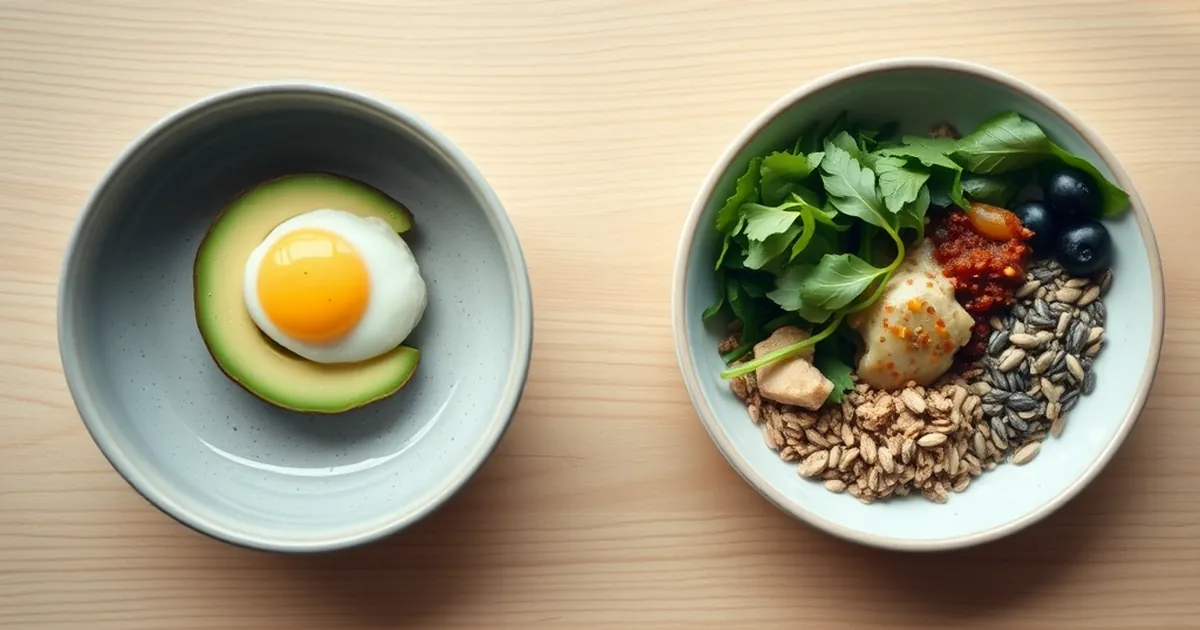
I keep noticing the same thing at lunch counters and in my own kitchen: the two-ingredient bowls — rice and beans, yogurt and berries, eggs and toast — feel more satisfying than the elaborate five-ingredient builds I used to assemble. That's not just a matter of effort. It raises a real question about how we decide what to eat and how our brains reward us for it.
Simplicity Wins on the Plate and in the Head
There's a well-known principle in cognitive psychology called choice overload. When people are presented with too many options, they often feel less satisfied with whatever they choose, even if the choice is objectively good. The classic example is the jam study from Sheena Iyengar and Mark Lepper in 2000: shoppers who saw 24 jam varieties were more likely to stop and look than shoppers who saw six, but only 3 percent of the big-display group actually bought a jar, compared with 30 percent of the small-display group.
That finding maps neatly onto bowl-building. A five-ingredient bowl forces a series of micro-decisions — which grain, which protein, which sauce, which crunch, which garnish — and each one creates a small opportunity for regret. A two-ingredient bowl collapses that decision tree into something your brain can process in a second. You eat it, you like it, you move on.
Fewer Ingredients, Cleaner Feedback
There's a subtler mechanism at work too, and it has to do with how we learn what we like. Behavioral psychologists describe variable-ratio reinforcement as the pattern where rewards arrive unpredictably — sometimes great, sometimes mediocre. It's a powerful driver of behavior, but it's also exhausting. A five-ingredient bowl is a small variable-ratio machine: some bites are transcendent, some are muddled, and you can't easily tell which ingredient was responsible.
A two-ingredient bowl gives you clean feedback. If the rice and beans taste flat, you know it's the rice or the beans — not the sauce competing with the pickled onion competing with the toasted seeds. That clarity makes it easier to improve the dish next time, and easier to feel like you're getting better at feeding yourself. Psychologists call this a sense of self-efficacy, and it's a quiet but real source of satisfaction.
The Loss Aversion Trap of Complicated Recipes
Daniel Kahneman and Amos Tversky's work on loss aversion showed that people feel losses roughly twice as intensely as equivalent gains. In the kitchen, this shows up as a reluctance to abandon an ingredient once you've bought it, prepped it, or committed it to the bowl. You add the fifth ingredient because leaving it out feels like waste — even if the bowl would taste better without it.
The two-ingredient approach sidesteps that trap entirely. There's nothing to waste because there's nothing extra. You're not managing a small inventory of obligations; you're just making lunch.
What This Means for the Next Meal You Build
Try this experiment this week: pick one meal and strip it to two ingredients, then eat it slowly and notice how satisfied you feel compared with your usual build. If the two-ingredient version holds up — and I suspect it will — you've found a shortcut that's also a small act of trust in your own taste. The five-ingredient bowl isn't going anywhere, but it doesn't need to be the default.