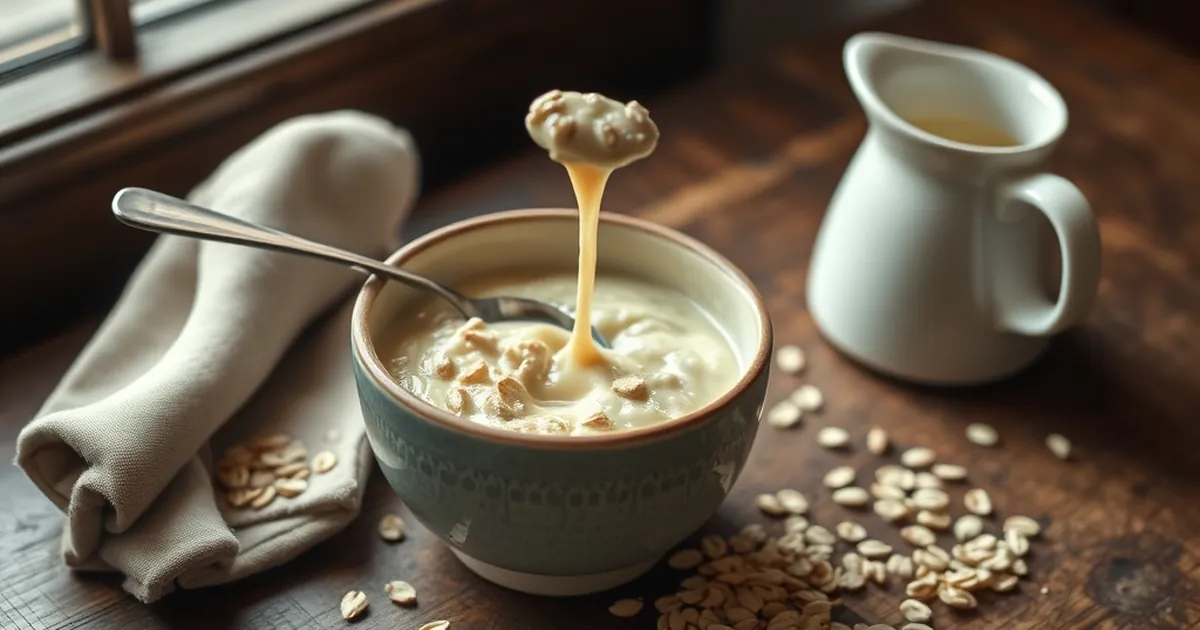
You know that moment of pure morning optimism—the kettle’s on, the berries are washed, and you’re looking forward to a cozy, creamy bowl of oats. Then, ten minutes later, you’re staring into a pale, rubbery slab that sits in the bowl like a science experiment gone wrong. It’s the breakfast equivalent of a flat tire, and it happens to the best of us.
The culprit isn’t your cooking skills, and it’s not a bad batch of grains. It’s usually a simple chemistry problem involving starch, liquid, and heat. Let’s break down exactly why your oatmeal turns gluey and, more importantly, how to rescue that perfect bowl of morning comfort.
The Starch Science: Why It Happens
Oats are packed with two types of starch: amylose and amylopectin. When you add heat and water, the starch granules swell and burst, releasing these molecules into the liquid. Amylose is the sneaky one—it creates that thick, sticky gel that can turn your breakfast into paste.
The problem is timing and agitation. When you stir too aggressively or too often, you break down the oat’s outer structure faster, releasing more amylose. You’re essentially forcing the oats to give up their gluey secrets. It’s also about the type of oat you’re using; steel-cut oats have a lower starch release rate than rolled oats, which is why they hold their shape better.
The Ratio Rule of Thumb
The most common mistake is playing fast and loose with the liquid ratio. If you use too little water or milk, the oats don’t have enough room to absorb moisture properly, so they cook unevenly and turn gummy. A good baseline is 1 part oats to 2 parts liquid for rolled oats, but you’ll want to bump that up to 2.5 or even 3 parts if you like a looser texture.
Three Fixes for a Fluffy Bowl
Here’s the good news: you don’t have to throw in the towel and grab a bagel. These small tweaks will change your oatmeal game forever.
1. The "Soak and Simmer" Method
Before you even turn on the stove, soak your oats in the liquid for at least 10 minutes (or overnight in the fridge). This pre-hydration lets the oats absorb water slowly, which means they need less aggressive cooking later. When you do heat them, use a gentle simmer rather than a rolling boil. A boil will jostle the starches too much, turning that pot into a glue factory.
2. Add the Salt and Fat Late
I used to toss everything in the pot at once—fruit, salt, sweetener—and then wonder why it was a mess. Salt actually strengthens the starch bonds, making the oatmeal firmer, but adding it too early can make the oats tough. Instead, add a pinch of salt halfway through cooking. For fat, stir in a teaspoon of butter, coconut oil, or a splash of nut milk after you take it off the heat. The fat coats the starch molecules, preventing them from linking up into that sticky web.
3. The Cold-Start Trick
Here’s a trick I picked up from a chef friend: start your oats in cold water and bring them up to temperature slowly. This gives the starches time to hydrate evenly without bursting all at once. It takes an extra three minutes, but the texture is noticeably creamier and more distinct. You get those soft, intact flakes rather than a homogeneous blob.
The "Oops" Rescue: Fixing a Batch Gone Wrong
We’ve all been there. You look into the pot and it’s already starting to look like wallpaper paste. Don’t panic—you can usually save it. The quickest fix is to whisk in a splash of cold milk or water immediately while it’s still hot. This lowers the temperature and stops the starch from continuing to set up.
If it’s already turned into a solid mass, your best move is to transfer it to a blender with a splash of milk and a banana. Blend it for 20 seconds and you’ve got a surprisingly delicious, thick smoothie bowl. I did this last Tuesday with a batch that looked like a lost cause, and honestly, it might have been better than the original plan.
The Takeaway: Embrace the "Barely Stirred" Method
The real secret to perfect oatmeal is to stop being so controlling. Once your oats are in the pot and the heat is on, walk away. Let them do their thing. Stir gently once at the halfway point and once at the end. That’s it. The less you interfere, the better the texture.
Think of it less like cooking and more like a gentle negotiation. You’re not forcing the oats to break down; you’re inviting them to soften at their own pace. Your mornings will be calmer, and your breakfast will actually look like the picture on the package.