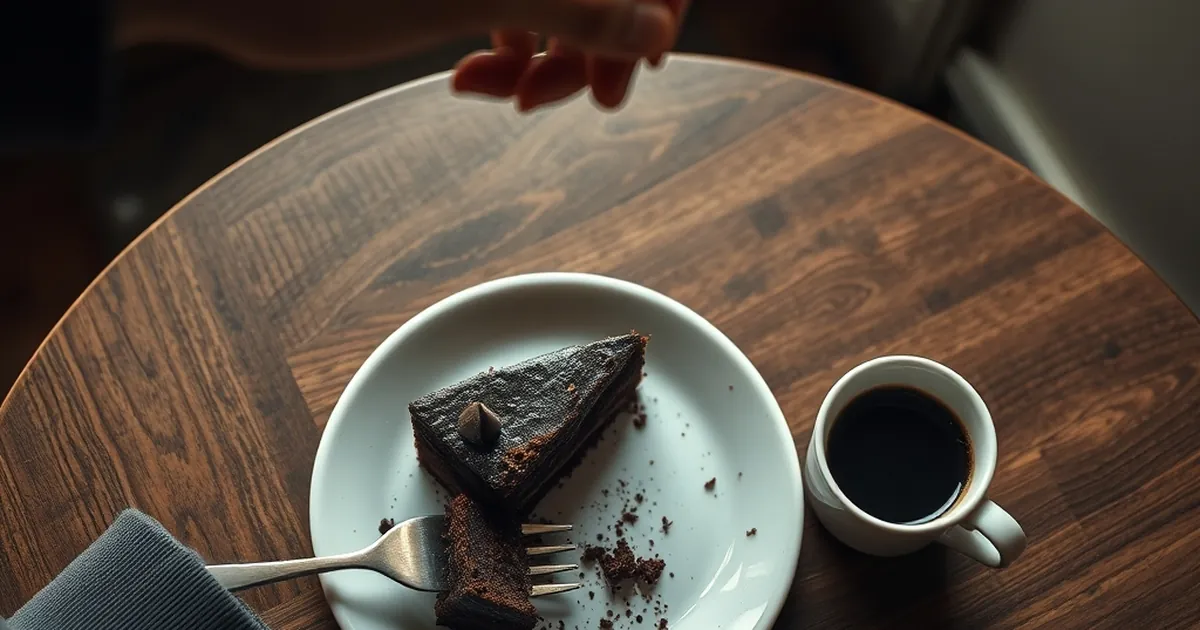
There's a moment at the café counter when you're three bites into a pastry you didn't plan on ordering, and the fourth bite is where something quietly shifts. Not the tenth. Not the last. The fourth. That's the bite where the decision to stop — or not — actually gets made, and most of us don't notice it happening.
So the question worth sitting with: why does self-control tend to collapse early in a meal rather than late, and what does that tell us about how we actually make food decisions?
The fourth bite is a decision point, not a flavor point
Behavioral researchers have a name for the friction that builds when you try to override an impulse: ego depletion, the idea that self-regulatory effort draws on a limited pool. The replication story on ego depletion is messier than the original 1998 Baumeister experiments suggested, but the practical pattern holds up in real cafés. The first few bites of a treat are automatic. The fourth is where you become aware you're still eating.
That awareness is the fork in the road. Before bite four, you're in motion. After bite four, you're choosing. And choosing is expensive.
Variable rewards keep you reaching
Bite one is reliably good. Bite two is good. Bite three is good. But bite four is where the texture, the sweetness, or the salt can surprise you — a little more jam than expected, a slightly better crust. That unpredictability is the same variable-ratio reinforcement schedule that makes slot machines and social media feeds so sticky, and it works on pastries too.
Your brain isn't rewarding the eating. It's rewarding the checking. Is this bite as good as the last? The answer is always uncertain, and uncertainty is what keeps the hand moving toward the plate.
Loss aversion shows up on the plate
Kahneman and Tversky's work on loss aversion — losses loom roughly twice as large as equivalent gains — explains why leaving three bites on the plate feels worse than eating them. You already paid. You already committed. Stopping now registers as a loss, even though the fourth bite is where marginal enjoyment starts to fall off a cliff.
The reframe that helps: the bites you don't eat aren't a loss. They're the price of stopping at the point where the food was still working for you.
Practical moves for the fourth-bite moment
- Put the fork down at bite three. Physically. Not mentally. The hand has to leave the plate.
- Drink water between bites three and five. It interrupts the automatic loop long enough for a real decision to form.
- Name the bite. "This is bite four" sounds ridiculous until you try it. Naming pulls the decision out of autopilot.
- Decide before you order, not during. The fourth-bite moment is a terrible time to make a policy decision. Make it at the counter.
What changes when you watch for it
Once you know bite four exists, you start noticing it everywhere — the second handful of chips, the third sip of a drink you didn't really want, the extra bite of a shared dessert. The point isn't to white-knuckle your way through meals. It's to stop treating willpower as a long-distance runner and start treating it as a sprinter that needs a rest at exactly the right moment.
Next time you're at a café, order what you actually want, then watch for bite four. That's the bite worth paying attention to. Everything after it is just momentum.