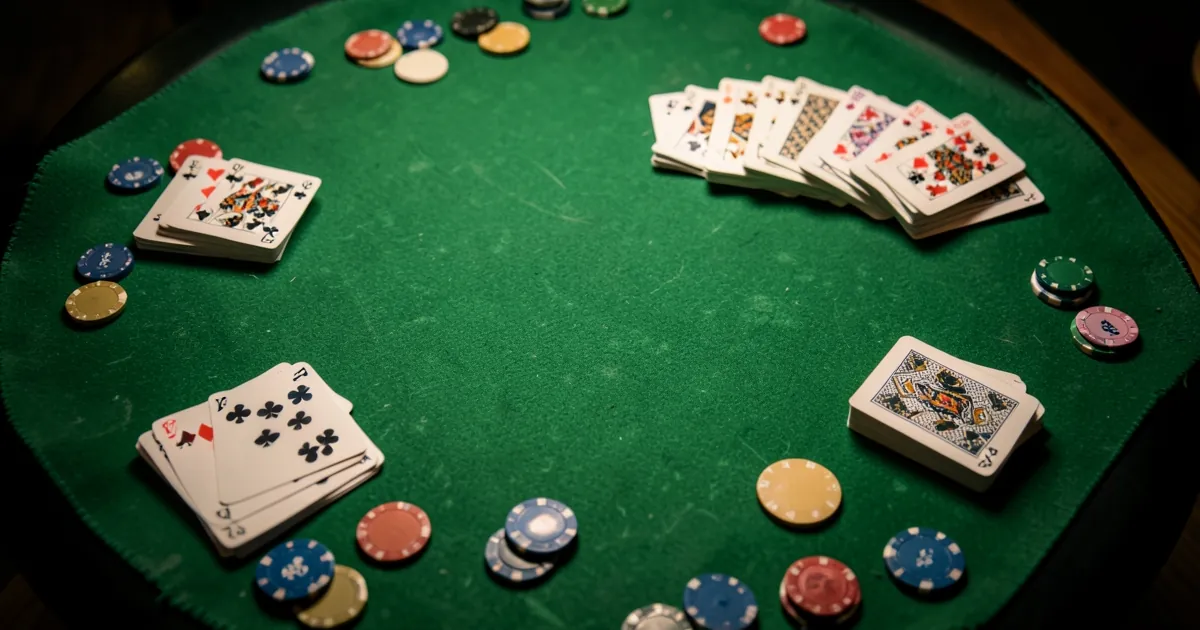
Blackjack Decks Explained: Why 6 Beat 1 on House Edge
Six decks is the blackjack standard for a reason: simulation shows single-deck play adds 0.3054 points to the house edge, and here is why
· 3 min read
Most blackjack tables you'll sit at deal from a shoe holding six or eight decks, and that's the answer to the search query: six decks is the standard, eight is the common alternative, and single-deck is the exception you have to hunt for. The reason isn't nostalgia for the old days — it's arithmetic. A Monte Carlo simulation of 480 million hands, published on Zenodo, found that switching a game from six decks down to one adds 0.3054 percentage points to the house edge. Fewer decks is worse for you, not better.
The deck-count effect, in numbers
That 0.3054 figure is the whole story in one line, but the interesting part is how it scales. The same study compared six decks against eight and found the move costs just 0.0046 percentage points. Going from six to eight decks barely registers. Going from six to one costs roughly 66 times as much.
The mechanism is composition. With one deck, every card you see changes the remaining pack meaningfully. A ten-rich deck is genuinely ten-rich. With six decks, removing one ace from 312 cards is a rounding error, so the shoe stays close to its starting composition no matter how the hand plays out. Card counters live and die on this, but it matters to plain basic-strategy players too: single-deck games reward sharper play and punish sloppy play more.
You can see it in the naturals. According to QFIT Blackjack's published figures, a natural blackjack lands 4.827% of the time in single-deck and 4.749% in six-deck. A gap of under one-tenth of a percentage point, and it's the largest single-deck advantage in the game.
Why casinos still push six and eight
Six-deck and eight-deck formats dominate casino floors and live dealer tables, per GamesHub's 2025 roundup, while single-deck games are scarce and often carry worse rules. That's not an accident of supply. A shoe that holds 312 cards lets a dealer deal dozens of hands between shuffles, which means more hands per hour — and more hands per hour is more exposure to the house edge, which is exactly what a casino wants.
Live dealer tables compound this. If you've read our piece on why six-seat live tables slow the deal by 23%, you know seat count and shuffle frequency move the effective hourly cost around more than most players expect. Deck count is one input in that equation, not the whole of it.
The rules around the decks matter more
Here's where the deck debate gets oversold. A six-deck game with hit soft 17, double after split, and a 3:2 payout carries a basic house advantage of about 0.69% with a cut card, according to Bill Zender's published analysis. That's a fair game by modern standards.
Now change the payout. The Zenodo study found that a 6:5 blackjack payout increases the house edge by 1.3605 percentage points on average — more than four times the entire deck-count effect. A single-deck game paying 6:5 is worse than a six-deck game paying 3:2, and it isn't close. Casinos know this, which is why the single-deck tables that survive often come with the worse payout attached.
Same logic applies to side bets and insurance. Our breakdown of how insurance adds roughly 11% to the live dealer house edge makes the point: the headline rule set gets the attention, the add-ons take the money.
What to check before you sit
Read the felt, not the deck count. In order of impact:
- Blackjack payout. 3:2 or walk. 6:5 costs you 1.36 points, full stop.
- Dealer hits or stands on soft 17. Hitting is worse for you.
- Double after split allowed? If not, add roughly a quarter point.
- Deck count. Six versus eight is noise. Six versus one is real, but only if the rules hold up.
If you want the longer version of how small edges compound, what a 3% house edge does over 500 bets is the honest math — and it's the reason a 0.3-point deck difference is worth caring about over a session but not worth chasing across a casino floor.
The question the numbers don't settle
If six decks cost players 0.3 points versus one deck, why hasn't a mid-sized operator built a single-deck game with 3:2 and full doubling and marketed it as the player-friendly table? The answer is probably throughput and hold — a single-deck game with good rules is a counter's playground, and the shuffle every few hands kills the hands-per-hour number. But that's a business calculation, not a law of the game. Somewhere a floor manager is doing the arithmetic on whether the marketing value of "best blackjack rules in the building" outweighs the cost. Wherever you play, set a loss limit before the first shuffle and treat the deck count as a footnote to it.