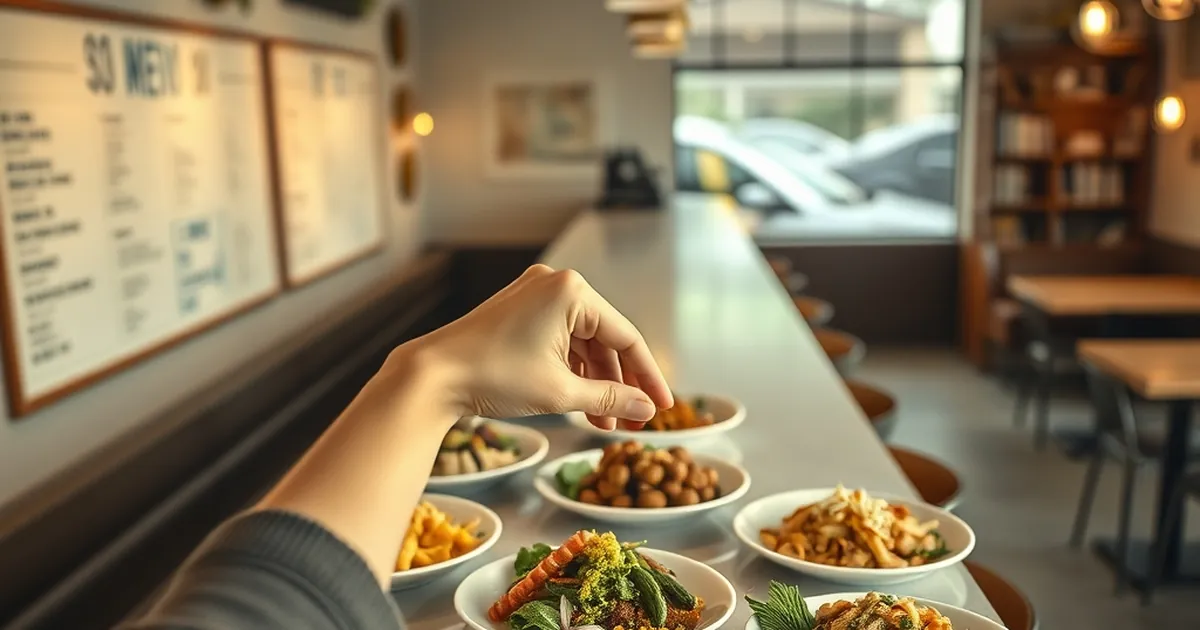
You're standing in line at a café, and the menu board has nineteen items. By the time you reach the register, you've stopped reading. You order the same cold brew and turkey sandwich you always get. Was that a decision, or just an exit? The answer matters more than you'd think — because the point where your brain gives up on a menu isn't where most people assume it is.
The Seventh Item Is Where the Wheels Come Off
Behavioral researchers studying choice overload keep landing on a similar range: somewhere between five and nine options, people start reporting lower satisfaction and higher regret, even when the options are genuinely good. That's the range where a menu stops feeling like abundance and starts feeling like homework.
What's interesting is the shape of the collapse. It isn't a slow decline across the whole board. It's more like a cliff. Items one through six get real consideration. Item seven gets a glance. Items eight through nineteen might as well be printed in a language you don't read.
Café owners intuit this and often fight it the wrong way. They add a "chef's choice" tag to item fourteen, hoping to rescue your attention. But attention isn't the bottleneck at that point. Motivation is.
Kahneman's System 2 Doesn't Have a Long Battery
The reason is roughly what Daniel Kahneman described in Thinking, Fast and Slow: deliberate, comparative reasoning — the kind you need to weigh a caprese panini against a miso grain bowl — is metabolically expensive and easily depleted. Your brain treats menu comparison as a cost with a small payoff, because the payoff is lunch, not a life outcome.
Once that cost-benefit math tips, you don't switch to a worse decision strategy. You switch to a cheaper one. Usually that means the default: whatever you had last time, whatever's closest to the register, whatever the person ahead of you ordered.
This is where variable-ratio reinforcement sneaks in, and it's worth being precise about it. If a café occasionally has a genuinely transcendent special — a soup that's better than anything else on the board — you learn to keep scanning the menu hoping to catch it. Intermittent reward keeps the search behavior alive longer than a steady reward would. That's the same mechanism that makes people pull a lever or refresh a feed. Here, it just makes you read eleven more items than you have the energy to actually evaluate.
What This Looks Like in a Real Café
A small chain in the Pacific Northwest ran an informal experiment a few years back: they cut a twelve-item lunch menu to seven and moved the daily special to the top. Average decision time dropped noticeably. So did the number of customers who asked the cashier "what's good?" — a reliable tell that someone has hit the wall.
The counterintuitive part: revenue didn't drop. It went up slightly. People who decide faster tend to add a pastry or upgrade the drink, because they still have decision budget left when they reach the register.
Design Your Own Menu, Even If You're Not a Café
If you're the one choosing, the fix isn't willpower. It's precommitment. Pick a category before you look at the board — "something with eggs" or "a grain bowl" — and let that constraint do the filtering. You've effectively cut the menu to four items before you start.
If you're the one building a menu, whether it's a café, a team lunch order, or a weekly meal plan, seven is a generous ceiling. Put your best item first. Rotate the specials so the scan stays rewarding without demanding a full evaluation every visit.
The next time you catch yourself reading item eleven, notice it. That's not indecision. That's your brain already ordering the cold brew and waiting for your mouth to catch up.