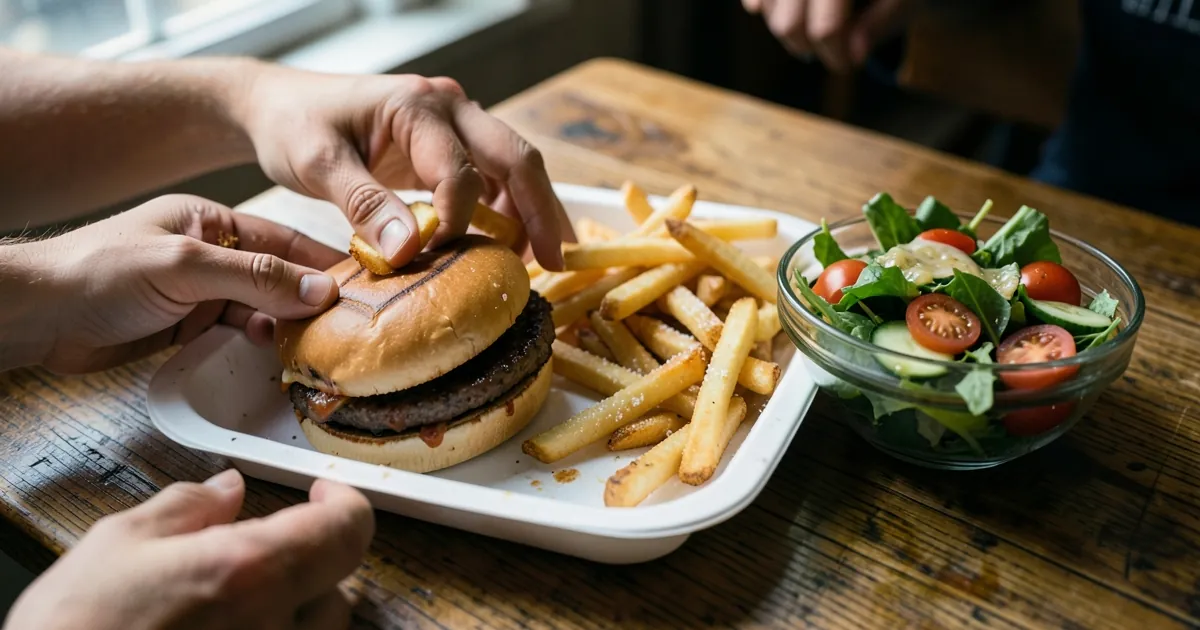
Why does a combo meal feel like something you accomplished? You didn't cook it. You didn't even really choose it—you picked option two from a board of six. Yet there's a small, unmistakable glow when the tray lands and the number on your receipt matches the number you had in mind. That gap between what actually happened (a fast, low-effort transaction) and what it feels like (a small personal victory) is worth poking at, because it shows up everywhere people make quick choices under time pressure.
The pride is real, and it isn't about the food
Behavioral economists have a term for the pleasure of a choice that resolves cleanly: it's a form of processing fluency. When something is easy to parse, we read that ease as a signal—sometimes about the thing itself, sometimes about ourselves. Combo meals are engineered for fluency. One price, one number, one decision. The cognitive load drops, and the brain quietly credits you for the smoothness.
That's the trick. The combo didn't ask much of you, but the feeling of resolution gets filed under "I handled that." It's the same reason a well-organized menu makes diners feel decisive. If you've read our breakdown of why a three-item combo beats build-your-own by two minutes, you've seen the raw mechanics: the combo wins on clock time, not on craft. But clock time is exactly what our egos tend to misread as competence.
Speed gets scored like skill
Here's where it gets interesting. In café settings, we've noticed that diners rate their own satisfaction partly through a skill lens—how well they "played" the menu. And that lens is sticky. Our piece on skill scores beating taste tests at the soup counter found that self-rated skill moved choices more than flavor ratings did. People weren't picking the tastiest bowl. They were picking the bowl that made them feel like a sharp operator.
Combo meals are perfectly built to feed that feeling. You scan, you commit, you're done. The build-your-own line asks you to weigh eight toppings and second-guess yourself—which is more work, but also more genuine authorship. Oddly, the easier path often produces the prouder diner.
A quick illustration
Picture two regulars at the same lunch counter. One orders the #4 without looking up from her phone. The other spends ninety seconds assembling a grain bowl with three swaps. Ask both how lunch went, and the #4 orderer is often the more satisfied—not because the food was better, but because her decision closed cleanly. The bowl-builder carries a faint residue of "did I get that right?" That residue is the tax on real choice.
Reward loops love a clean finish
There's a variable-reward angle too, though subtler than the classic reinforcement schedules. A combo meal delivers a predictable hit of completion—and predictable completion is its own quiet loop. You don't need uncertainty to feel a pull; a reliable "done" is enough to keep the habit warm. What makes it feel skillful is the framing: the menu presents the combo as a smart play, and we tend to accept the frame.
This is why speed-eating contexts amplify everything. When the clock runs, diners bulk up their orders and lean harder on shortcuts, as we saw in how speed eaters add 30% more sides when time is short. Under pressure, the combo isn't just convenient—it feels like the correct move, and correctness is emotionally close to pride.
What to do with this
If you run a café or design a menu, the lesson isn't "make everything a combo." It's that diners are quietly grading themselves, and your layout is the exam. Give people one clean, confident path and they'll credit themselves for taking it—then come back for the same feeling.
If you're the diner, try a small experiment this week: order the combo, then ask yourself honestly whether the glow came from the food or from the decision closing. You might find that the pride is a receipt for speed, not skill. And once you can name that, you get to choose which one you actually want—sometimes the slower, clumsier, more authored bowl is the one worth feeling good about.