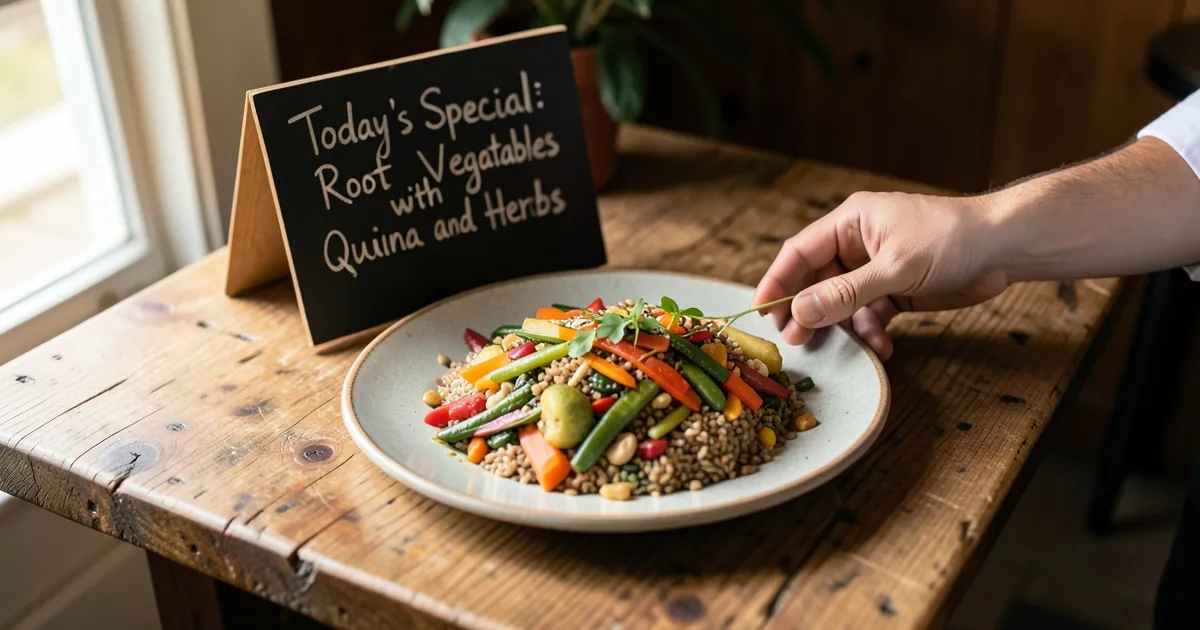
When the Menu Says "Chef's Choice," Diners Trust It More
A Swedish restaurant experiment reveals why chef's choice labels earn more trust than detailed menu descriptions
· 3 min read
The menu sits there, and one line refuses to explain itself: "Chef's choice." No ingredient list, no calorie count, no hint of what arrives. Why does that blank space so often beat the dish that spells everything out?
The answer has less to do with food than with how we hand off decisions — and a small Swedish field experiment from 2025 offers a clean test of it.
The Experiment That Put Two Labels on the Same Lentils
Researchers working in a Swedish restaurant took a vegetarian dish that wasn't selling well — lentils with a "zero-waste" pesto — and changed only the words above it. Over four weeks, with 1,540 dishes sold and 524 customers answering a survey, calling it "Chef's choice" nudged people toward it. Calling the identical dish "Guests' choice" changed nothing.
That gap is the interesting part. Both labels are a recommendation. Both reduce effort. But one carries a voice with assumed expertise behind it, and the other sounds like a crowd poll — which, as it turns out, diners already conduct on their own.
Expertise Is a Shortcut, Popularity Is a Copy
A 2022 randomized field experiment at food festivals found something adjacent: "baker's choice" tags didn't move choices much, while "most popular" labels did. So the picture isn't simply "any guidance works." It depends on what kind of uncertainty the label resolves.
"Chef's choice" resolves uncertainty about quality: someone who knows the kitchen has made a judgment on your behalf. "Most popular" resolves uncertainty about safety: other people have already screened this. Both work. "Guests' choice" sits awkwardly between them, offering neither authority nor evidence.
This is where choice architecture meets behavioral psychology. We are not optimizing for the best dish; we're optimizing for the least regret. That instinct shows up everywhere on a menu. It's why diners who fear a bad pick tend to reorder the same bowl rather than risk a new one, and why the position of an item can matter as much as its contents — the pull toward the third item on a list is a documented pattern, not a coincidence.
Why a Blank Description Feels Like a Promise
Iyengar and Lepper's well-known 2000 jam study is the classic illustration of what too much choice costs: 30% of shoppers bought from a display of 6 jams, against 3% from a display of 24. Fewer, clearer options get acted on. But there's a second lesson buried in it — a curated set implies a curator. Someone chose these six. That implication is doing quiet work.
A "Chef's choice" line is that curator made explicit. It converts a long menu into a short one without deleting anything, which matters because long menus measurably slow decisions down well before diners reach the end. And it does so without the cost of a hard restriction, which people tend to resist.
There's a social wrinkle worth knowing. Research by Ariely and Levav found that when menu choices were made privately, people were more likely to order what those before them had ordered — and were happier with the result. We read the room even when nobody's watching. A chef's recommendation gives that instinct something legitimate to lean on.
What Cafés Should Do With This
The practical takeaway isn't "add 'chef's choice' to everything." It's to be deliberate about which kind of uncertainty you're solving for.
- If the dish is unfamiliar or a hard sell, attach a named authority. A specific person — the chef, the baker, the person who developed the recipe — beats a generic endorsement.
- If the dish is already liked, lead with popularity instead. "Most ordered this month" is a different, equally valid lever.
- Don't split the difference. Labels that gesture at consensus without evidence, or at expertise without a name, tend to land flat.
The National Restaurant Association's 2026 forecast, drawing on a survey of hundreds of US culinary professionals, put clear menu labelling and cues among the top overall menu trends — so expect more of these signals, not fewer. The ones that will earn their space are the ones that answer a real question a diner is already asking.